Fifteen-plus years of BC mortgage experience, distilled into practical writing on buying, renewing, refinancing, and building wealth through real estate.
What a 50% Tariff on Canadian Exports Actually Costs: Auto Plants, Lumber Mills, and Your Grocery Bill
A Ford F-150 crosses the Ambassador Bridge from Windsor to Detroit seventeen times before it's finished. The engine block was cast in Windsor, shipped to Dearborn for assembly, sent back to Windsor for transmission mating, returned again for final body mounting. A 50% tariff doesn't hit that truck once. It hits it seventeen times.
The proposed tariff, announced July 2026, conveniently timed with the CUSMA review window, targets roughly 75% of Canadian goods exports to the U.S., a trade flow worth $1.3 trillion CAD annually. The White House frames this as leverage. What it actually is: a tax on U.S. manufacturers who built their supply chains around the assumption that the border was permeable.
Where the Math Breaks First
Start with autos. A $45,000 pickup built under integrated North American production contains roughly $18,000 in parts that cross the border multiple times. Apply a 50% tariff to each crossing and the landed cost of those parts rises by $4,500 to $9,000, depending on the number of trips. The automaker has three options: eat the cost (impossible at current margins), pass it to the buyer (a $50,000 truck becomes $55,000), or scramble to reshore production of every affected component within 18 months (not physically achievable given tooling lead times).
Ford's Oakville plant, which builds the Edge and Nautilus, sources 60% of its components from U.S. suppliers. Those U.S. parts often contain Canadian steel, aluminum, or sub-assemblies. The tariff punishes the whole chain. GM's CAMI plant in Ingersoll, which makes commercial vans sold almost entirely into the U.S. market, becomes uncompetitive overnight. Not against foreign imports, against U.S.-built vans that suddenly don't carry the tariff load.
Lumber, Energy, and the Inflation Nobody Wants
Canada ships over 4 million barrels of oil per day to U.S. refineries, roughly 60% of total U.S. crude imports. A 50% tariff on Canadian heavy crude translates to an immediate $30-per-barrel cost increase at the refinery gate. U.S. gasoline prices, already politically sensitive, spike by $0.40 to $0.60 per gallon within weeks. The administration can carve out energy under national security exemptions, but that undercuts the "broad tariff" framing and invites every other sector to lobby for the same treatment.
Lumber is simpler and worse. Canada supplies roughly one-third of the softwood lumber used in U.S. residential construction. A 50% tariff raises the cost of framing a 2,000-square-foot house by $7,000 to $9,000. U.S. mills cannot scale fast enough to replace Canadian supply, most operable timber is already being cut. Housing starts, which the administration wants to boost, slow instead. New home prices rise. Existing home prices follow.
The Retaliation Playbook
Canada's 2018 response to steel and aluminum tariffs was surgical: $16.6 billion in counter-tariffs on Florida orange juice, Kentucky bourbon, Wisconsin dairy, North Carolina furniture. The target list was a political map. Every product came from a district the White House needed.
Expect the same this time, but larger. Ontario and Quebec premiers are already forming a coalition to lobby U.S. governors in Michigan, Ohio, and Pennsylvania, states where auto jobs depend on cross-border parts flow. The Canadian Dollar will weaken, possibly to $0.68 USD, which makes Canadian exports cheaper and blunts some of the tariff's bite. But currency devaluation is a partial offset, not a solution.
The CUSMA review was supposed to be a calibration. This is a wrecking ball. The question isn't whether the tariff damages both economies, it does. The question is whether that damage is the point.


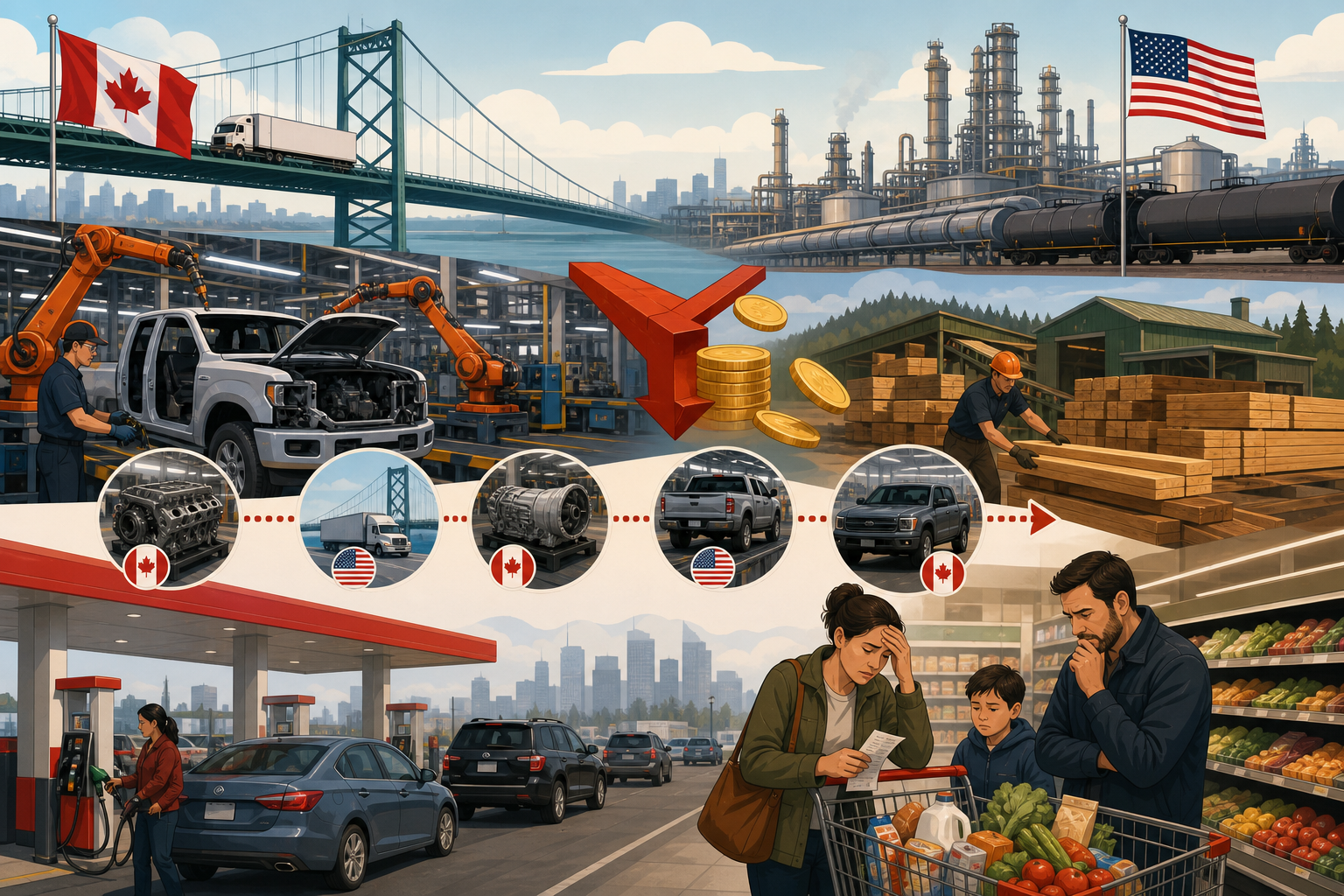

A Ford F-150 crosses the Ambassador Bridge from Windsor to Detroit seventeen times before it's finished. The engine block was cast in Windsor, shipped to Dearborn for assembly, sent back to Windsor for transmission mating, returned again for final body mounting. A 50% tariff doesn't hit that truck once. It hits it seventeen times.
The proposed tariff, announced July 2026, conveniently timed with the CUSMA review window, targets roughly 75% of Canadian goods exports to the U.S., a trade flow worth $1.3 trillion CAD annually. The White House frames this as leverage. What it actually is: a tax on U.S. manufacturers who built their supply chains around the assumption that the border was permeable.
Where the Math Breaks First
Start with autos. A $45,000 pickup built under integrated North American production contains roughly $18,000 in parts that cross the border multiple times. Apply a 50% tariff to each crossing and the landed cost of those parts rises by $4,500 to $9,000, depending on the number of trips. The automaker has three options: eat the cost (impossible at current margins), pass it to the buyer (a $50,000 truck becomes $55,000), or scramble to reshore production of every affected component within 18 months (not physically achievable given tooling lead times).
Ford's Oakville plant, which builds the Edge and Nautilus, sources 60% of its components from U.S. suppliers. Those U.S. parts often contain Canadian steel, aluminum, or sub-assemblies. The tariff punishes the whole chain. GM's CAMI plant in Ingersoll, which makes commercial vans sold almost entirely into the U.S. market, becomes uncompetitive overnight. Not against foreign imports, against U.S.-built vans that suddenly don't carry the tariff load.
Lumber, Energy, and the Inflation Nobody Wants
Canada ships over 4 million barrels of oil per day to U.S. refineries, roughly 60% of total U.S. crude imports. A 50% tariff on Canadian heavy crude translates to an immediate $30-per-barrel cost increase at the refinery gate. U.S. gasoline prices, already politically sensitive, spike by $0.40 to $0.60 per gallon within weeks. The administration can carve out energy under national security exemptions, but that undercuts the "broad tariff" framing and invites every other sector to lobby for the same treatment.
Lumber is simpler and worse. Canada supplies roughly one-third of the softwood lumber used in U.S. residential construction. A 50% tariff raises the cost of framing a 2,000-square-foot house by $7,000 to $9,000. U.S. mills cannot scale fast enough to replace Canadian supply, most operable timber is already being cut. Housing starts, which the administration wants to boost, slow instead. New home prices rise. Existing home prices follow.
The Retaliation Playbook
Canada's 2018 response to steel and aluminum tariffs was surgical: $16.6 billion in counter-tariffs on Florida orange juice, Kentucky bourbon, Wisconsin dairy, North Carolina furniture. The target list was a political map. Every product came from a district the White House needed.
Expect the same this time, but larger. Ontario and Quebec premiers are already forming a coalition to lobby U.S. governors in Michigan, Ohio, and Pennsylvania, states where auto jobs depend on cross-border parts flow. The Canadian Dollar will weaken, possibly to $0.68 USD, which makes Canadian exports cheaper and blunts some of the tariff's bite. But currency devaluation is a partial offset, not a solution.
The CUSMA review was supposed to be a calibration. This is a wrecking ball. The question isn't whether the tariff damages both economies, it does. The question is whether that damage is the point.
Read Next
Apple's Price-to-Earnings Ratio Isn't Insane, It's Ecosystem Math
Canada Lost 55,000 People This Quarter, So Why Aren't Home Prices Following?
CRA's New Billion-Dollar Ruling Program: How to Lock in Tax Certainty Before You Build
Why Porting Your 2.7% Mortgage Could Cost You $47,000 More Than Breaking It