Fifteen-plus years of BC mortgage experience, distilled into practical writing on buying, renewing, refinancing, and building wealth through real estate.
Smart home devices cut insurance premiums by catching risks before they cost you
A 47-year-old accountant in Mississauga discovered her basement had been flooding for six hours while she slept. The leak started at 2 a.m. Her water sensor sent an alert to her phone at 2:03 a.m. She didn't see it until morning. The damage still happened, but the claim was $4,200 instead of what her insurer estimated would have been $18,000 if the water had run until she left for work at 8 a.m. Her premium went up after the claim, but less than it would have otherwise. The sensor had done its job.
This is the shift happening in Canadian property and auto insurance. The discount for installing smart devices is visible, most major carriers now offer 5 to 25 percent off for telematics apps or connected home sensors. What's less visible is the structural change underneath. Insurers are moving from a model built around paying for damage after it happens to one built around preventing the damage from happening at all.
The monitoring starts before the policy does
Usage-based insurance programs, regulated by provincial bodies like the Financial Services Regulatory Authority of Ontario, now represent the default entry point for new auto policyholders seeking the lowest available rate. Signing up for telematics earns an immediate discount, often 5 to 10 percent, before the app has logged a single kilometre. The actual driving data determines whether the discount grows (safe drivers can see reductions approaching 30 percent in some provinces) or whether it stays at the enrollment floor.
The value isn't just the discount. The app creates a feedback loop. Hard braking shows up as a logged event. Drivers see it. The awareness changes behaviour, which lowers risk, which justifies the discount. The insurer isn't guessing about your annual mileage or your commute pattern anymore. They're measuring it, and the price follows.
For remote workers, this is arbitrage. A Toronto postal code might carry high auto premiums based on dense traffic and theft rates. But if your actual annual mileage has dropped from 18,000 kilometres to under 5,000 because you no longer commute, the telematics data proves it. The price adjusts downward even though your address hasn't changed.
Water damage drives the property side
Water claims are the leading cause of home insurance payouts in Canada, ahead of fire. The Insurance Bureau of Canada pegs water damage as responsible for nearly half of all residential claims by dollar value. Installing an automatic shut-off valve, a device that stops water flow the moment a leak is detected, can reduce the risk of a catastrophic flood by roughly 90 percent. Some insurers now provide the hardware for free to policyholders in flood-prone areas.
The pitch isn't just the premium discount. It's the concierge layer. High-end carriers are starting to bundle monitoring with service dispatch. If your sensor detects a leak, the insurer calls the plumber for you. The insurance product becomes a service instead of a passive contract you file away and hope never to use.
The privacy cost is real
The discount is effectively payment for data. A telematics app tracks your location, speed, braking patterns, and time of day continuously. A smart home system knows when you're away, when you're asleep, what rooms you occupy. That data is governed by the Personal Information Protection and Electronic Documents Act, which requires transparency about what gets collected and how it's used. But transparency isn't the same as control. Once the data leaves the device, you're trusting the insurer's data governance policies.
Some programs use the data only to offer discounts. Others reserve the right to increase premiums or remove discounts at renewal if the driving data shows high-risk patterns. The difference matters. Read the terms.
The deeper trade-off is behavioural. A sensor that prevents a $15,000 flood has clear value. A telematics app that logs every trip turns your car into a workplace where your performance is continuously evaluated. Whether that's worth $400 a year in savings depends on how you value autonomy versus price.
The technology isn't optional anymore. Carriers price their standard policies assuming you didn't install the monitoring. That assumption costs you.


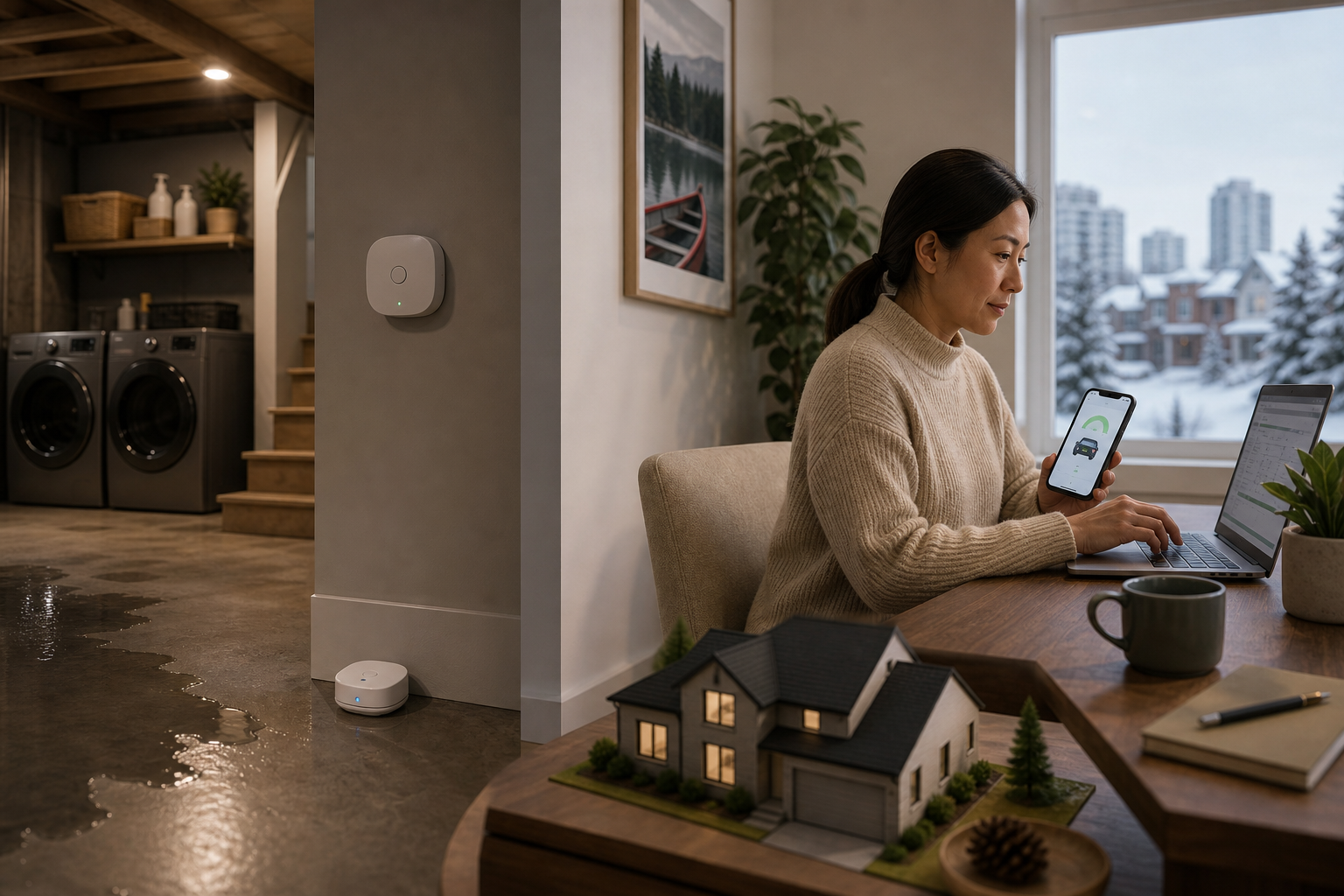

A 47-year-old accountant in Mississauga discovered her basement had been flooding for six hours while she slept. The leak started at 2 a.m. Her water sensor sent an alert to her phone at 2:03 a.m. She didn't see it until morning. The damage still happened, but the claim was $4,200 instead of what her insurer estimated would have been $18,000 if the water had run until she left for work at 8 a.m. Her premium went up after the claim, but less than it would have otherwise. The sensor had done its job.
This is the shift happening in Canadian property and auto insurance. The discount for installing smart devices is visible, most major carriers now offer 5 to 25 percent off for telematics apps or connected home sensors. What's less visible is the structural change underneath. Insurers are moving from a model built around paying for damage after it happens to one built around preventing the damage from happening at all.
The monitoring starts before the policy does
Usage-based insurance programs, regulated by provincial bodies like the Financial Services Regulatory Authority of Ontario, now represent the default entry point for new auto policyholders seeking the lowest available rate. Signing up for telematics earns an immediate discount, often 5 to 10 percent, before the app has logged a single kilometre. The actual driving data determines whether the discount grows (safe drivers can see reductions approaching 30 percent in some provinces) or whether it stays at the enrollment floor.
The value isn't just the discount. The app creates a feedback loop. Hard braking shows up as a logged event. Drivers see it. The awareness changes behaviour, which lowers risk, which justifies the discount. The insurer isn't guessing about your annual mileage or your commute pattern anymore. They're measuring it, and the price follows.
For remote workers, this is arbitrage. A Toronto postal code might carry high auto premiums based on dense traffic and theft rates. But if your actual annual mileage has dropped from 18,000 kilometres to under 5,000 because you no longer commute, the telematics data proves it. The price adjusts downward even though your address hasn't changed.
Water damage drives the property side
Water claims are the leading cause of home insurance payouts in Canada, ahead of fire. The Insurance Bureau of Canada pegs water damage as responsible for nearly half of all residential claims by dollar value. Installing an automatic shut-off valve, a device that stops water flow the moment a leak is detected, can reduce the risk of a catastrophic flood by roughly 90 percent. Some insurers now provide the hardware for free to policyholders in flood-prone areas.
The pitch isn't just the premium discount. It's the concierge layer. High-end carriers are starting to bundle monitoring with service dispatch. If your sensor detects a leak, the insurer calls the plumber for you. The insurance product becomes a service instead of a passive contract you file away and hope never to use.
The privacy cost is real
The discount is effectively payment for data. A telematics app tracks your location, speed, braking patterns, and time of day continuously. A smart home system knows when you're away, when you're asleep, what rooms you occupy. That data is governed by the Personal Information Protection and Electronic Documents Act, which requires transparency about what gets collected and how it's used. But transparency isn't the same as control. Once the data leaves the device, you're trusting the insurer's data governance policies.
Some programs use the data only to offer discounts. Others reserve the right to increase premiums or remove discounts at renewal if the driving data shows high-risk patterns. The difference matters. Read the terms.
The deeper trade-off is behavioural. A sensor that prevents a $15,000 flood has clear value. A telematics app that logs every trip turns your car into a workplace where your performance is continuously evaluated. Whether that's worth $400 a year in savings depends on how you value autonomy versus price.
The technology isn't optional anymore. Carriers price their standard policies assuming you didn't install the monitoring. That assumption costs you.
Read Next
Apple's Price-to-Earnings Ratio Isn't Insane, It's Ecosystem Math
Canada Lost 55,000 People This Quarter, So Why Aren't Home Prices Following?
CRA's New Billion-Dollar Ruling Program: How to Lock in Tax Certainty Before You Build
Why Porting Your 2.7% Mortgage Could Cost You $47,000 More Than Breaking It