Fifteen-plus years of BC mortgage experience, distilled into practical writing on buying, renewing, refinancing, and building wealth through real estate.
How to Layer Ontario's Temporary HST Rebate With Your FHSA for Maximum First-Time Buyer Savings
A 27-year-old engineer in Barrie contributes $8,000 to her FHSA in January, gets a $2,400 tax refund in April, and uses that refund to pay her land transfer tax in June. The rebate funded the tax. That's the loop.
Ontario's temporary HST rebate increase on new construction (introduced to boost supply) is the highest-leverage piece most first-time buyers aren't using. The federal FHSA gets all the press. The RRSP Home Buyers' Plan gets the LinkedIn posts. But the HST rebate is cash back at closing, not a deferred tax play. When you layer all three correctly, you're pulling $60,000 from tax-sheltered accounts and clawing back up to $24,000 in HST on the provincial side alone. That's $84,000 in effective purchasing power you didn't have by using just one tool.
Start with the FHSA, not the RRSP HBP
The FHSA is the only account where contributions are tax-deductible and withdrawals for a home purchase are tax-free. No repayment. Ever. The RRSP HBP lets you borrow $60,000 from your own retirement savings, but you have to pay it back over 15 years starting in year five. If you skip a repayment, it gets added to your taxable income.
Max the FHSA first: $8,000 per year, up to $40,000 lifetime. If you're buying with a spouse, that's $80,000 combined with zero repayment obligations. Only after the FHSA is exhausted do you touch the HBP. This sequencing matters because the FHSA is a grant, not a loan.
Set up the contribution in early January. The tax refund arrives in April or May. Use that refund to pay Ontario's land transfer tax (up to $4,000 refunded for first-time buyers) or to cover the HST adjustment at closing. You are letting the government pay the friction costs.
The HST rebate applies only to new builds
Ontario's provincial HST rebate can return up to $24,000 on new construction homes priced below $450,000. Above that threshold, the federal portion phases out, but the provincial portion remains available on higher-priced homes up to a cap. Resale homes don't qualify. This is the critical fork: if you're looking at resale, you get the FHSA and the HBP. If you're looking at new construction, you get all three.
The builder often "assigns" the rebate to you at closing, which reduces your final cash-to-close amount rather than requiring you to apply for it later. Confirm this with your lawyer before signing. Some builders pass it through automatically. Others require you to file after the fact, which delays access to the funds by 6-8 months.
The rebate calculation is based on the purchase price, not the amount financed. A $500,000 new townhouse in Ottawa qualifies for the provincial rebate even though the federal portion is lost above $450,000. You're recovering roughly 75% of the provincial HST paid, which works out to real money when the tax itself is $40,000.
The repayment trap most people miss
Buyers who max out both the FHSA ($40,000) and the HBP ($60,000) often assume the hard part is over. The FHSA has no repayment. The HBP does. You must repay one-fifteenth of the withdrawn amount each year starting in year five. For a $60,000 withdrawal, that's $4,000 per year. If you miss a payment, the CRA adds $4,000 to your taxable income that year, which at a marginal rate of 29.65% costs you an extra $1,186 in tax.
Homeowners who refinance, have kids, or face unexpected expenses in years five through seven are the most likely to miss HBP repayments. Set a calendar reminder for year four. Automate the repayment as a monthly RRSP contribution if your cash flow allows it.
What happens if you don't buy
If you open an FHSA and don't purchase a home within 15 years, the account must be closed. The balance transfers to your RRSP or RRIF without affecting your existing contribution room. You lose no capital. You simply convert a no-repayment home savings account into a regular retirement account. This makes the FHSA a zero-risk vehicle even if your plans change.
The stacking order that works: FHSA until maxed, then HBP if needed, with the HST rebate applied at closing on new builds only. The refund loop pays your land transfer tax. The HBP repayment starts in year five. Set the reminder now.


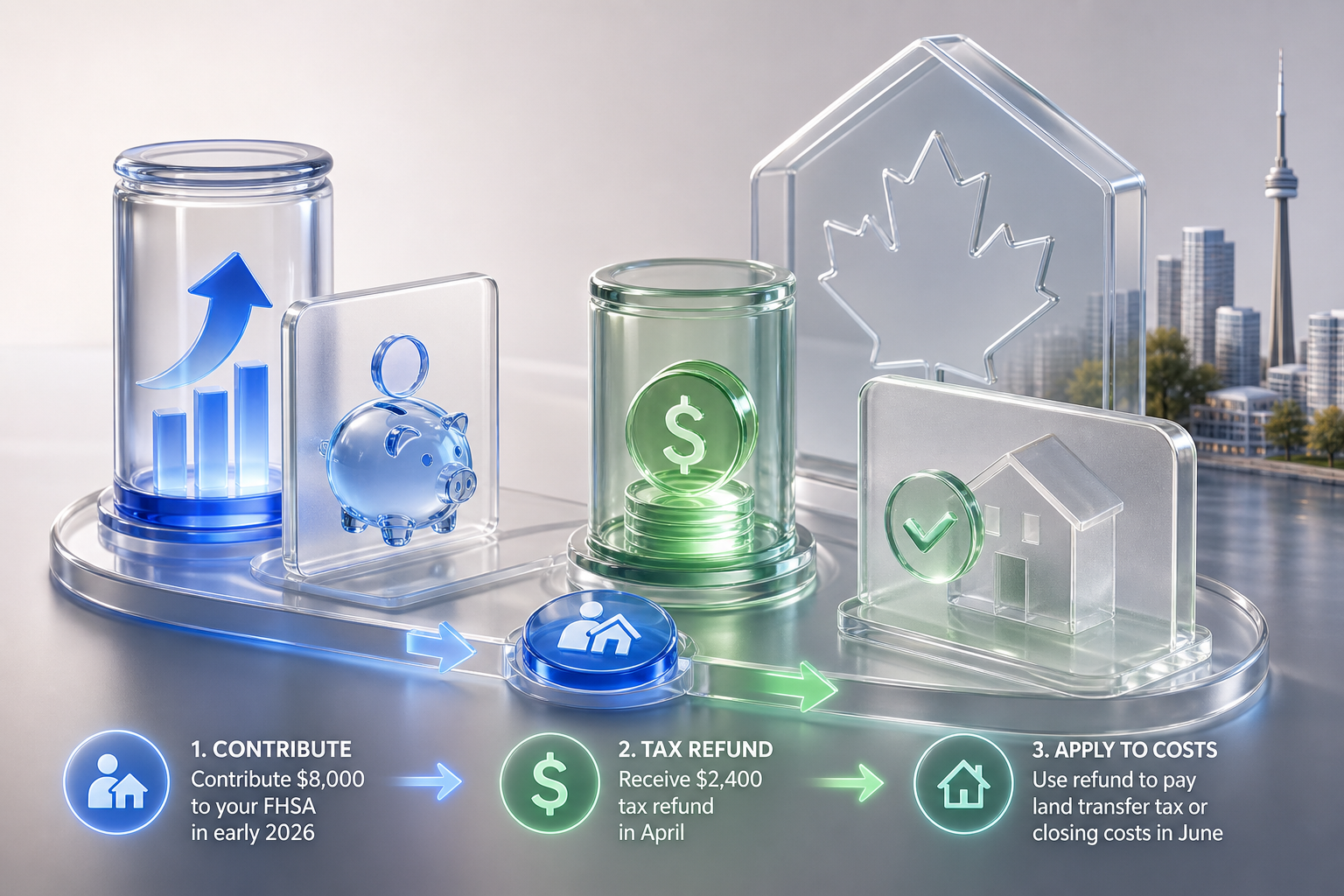

A 27-year-old engineer in Barrie contributes $8,000 to her FHSA in January, gets a $2,400 tax refund in April, and uses that refund to pay her land transfer tax in June. The rebate funded the tax. That's the loop.
Ontario's temporary HST rebate increase on new construction (introduced to boost supply) is the highest-leverage piece most first-time buyers aren't using. The federal FHSA gets all the press. The RRSP Home Buyers' Plan gets the LinkedIn posts. But the HST rebate is cash back at closing, not a deferred tax play. When you layer all three correctly, you're pulling $60,000 from tax-sheltered accounts and clawing back up to $24,000 in HST on the provincial side alone. That's $84,000 in effective purchasing power you didn't have by using just one tool.
Start with the FHSA, not the RRSP HBP
The FHSA is the only account where contributions are tax-deductible and withdrawals for a home purchase are tax-free. No repayment. Ever. The RRSP HBP lets you borrow $60,000 from your own retirement savings, but you have to pay it back over 15 years starting in year five. If you skip a repayment, it gets added to your taxable income.
Max the FHSA first: $8,000 per year, up to $40,000 lifetime. If you're buying with a spouse, that's $80,000 combined with zero repayment obligations. Only after the FHSA is exhausted do you touch the HBP. This sequencing matters because the FHSA is a grant, not a loan.
Set up the contribution in early January. The tax refund arrives in April or May. Use that refund to pay Ontario's land transfer tax (up to $4,000 refunded for first-time buyers) or to cover the HST adjustment at closing. You are letting the government pay the friction costs.
The HST rebate applies only to new builds
Ontario's provincial HST rebate can return up to $24,000 on new construction homes priced below $450,000. Above that threshold, the federal portion phases out, but the provincial portion remains available on higher-priced homes up to a cap. Resale homes don't qualify. This is the critical fork: if you're looking at resale, you get the FHSA and the HBP. If you're looking at new construction, you get all three.
The builder often "assigns" the rebate to you at closing, which reduces your final cash-to-close amount rather than requiring you to apply for it later. Confirm this with your lawyer before signing. Some builders pass it through automatically. Others require you to file after the fact, which delays access to the funds by 6-8 months.
The rebate calculation is based on the purchase price, not the amount financed. A $500,000 new townhouse in Ottawa qualifies for the provincial rebate even though the federal portion is lost above $450,000. You're recovering roughly 75% of the provincial HST paid, which works out to real money when the tax itself is $40,000.
The repayment trap most people miss
Buyers who max out both the FHSA ($40,000) and the HBP ($60,000) often assume the hard part is over. The FHSA has no repayment. The HBP does. You must repay one-fifteenth of the withdrawn amount each year starting in year five. For a $60,000 withdrawal, that's $4,000 per year. If you miss a payment, the CRA adds $4,000 to your taxable income that year, which at a marginal rate of 29.65% costs you an extra $1,186 in tax.
Homeowners who refinance, have kids, or face unexpected expenses in years five through seven are the most likely to miss HBP repayments. Set a calendar reminder for year four. Automate the repayment as a monthly RRSP contribution if your cash flow allows it.
What happens if you don't buy
If you open an FHSA and don't purchase a home within 15 years, the account must be closed. The balance transfers to your RRSP or RRIF without affecting your existing contribution room. You lose no capital. You simply convert a no-repayment home savings account into a regular retirement account. This makes the FHSA a zero-risk vehicle even if your plans change.
The stacking order that works: FHSA until maxed, then HBP if needed, with the HST rebate applied at closing on new builds only. The refund loop pays your land transfer tax. The HBP repayment starts in year five. Set the reminder now.
Read Next
Apple's Price-to-Earnings Ratio Isn't Insane, It's Ecosystem Math
Canada Lost 55,000 People This Quarter, So Why Aren't Home Prices Following?
CRA's New Billion-Dollar Ruling Program: How to Lock in Tax Certainty Before You Build
Why Porting Your 2.7% Mortgage Could Cost You $47,000 More Than Breaking It