Fifteen-plus years of BC mortgage experience, distilled into practical writing on buying, renewing, refinancing, and building wealth through real estate.
How to Layer Ontario's New HST Rebate With FHSA and RRSP Withdrawals to Save $64,000 on Your First Home
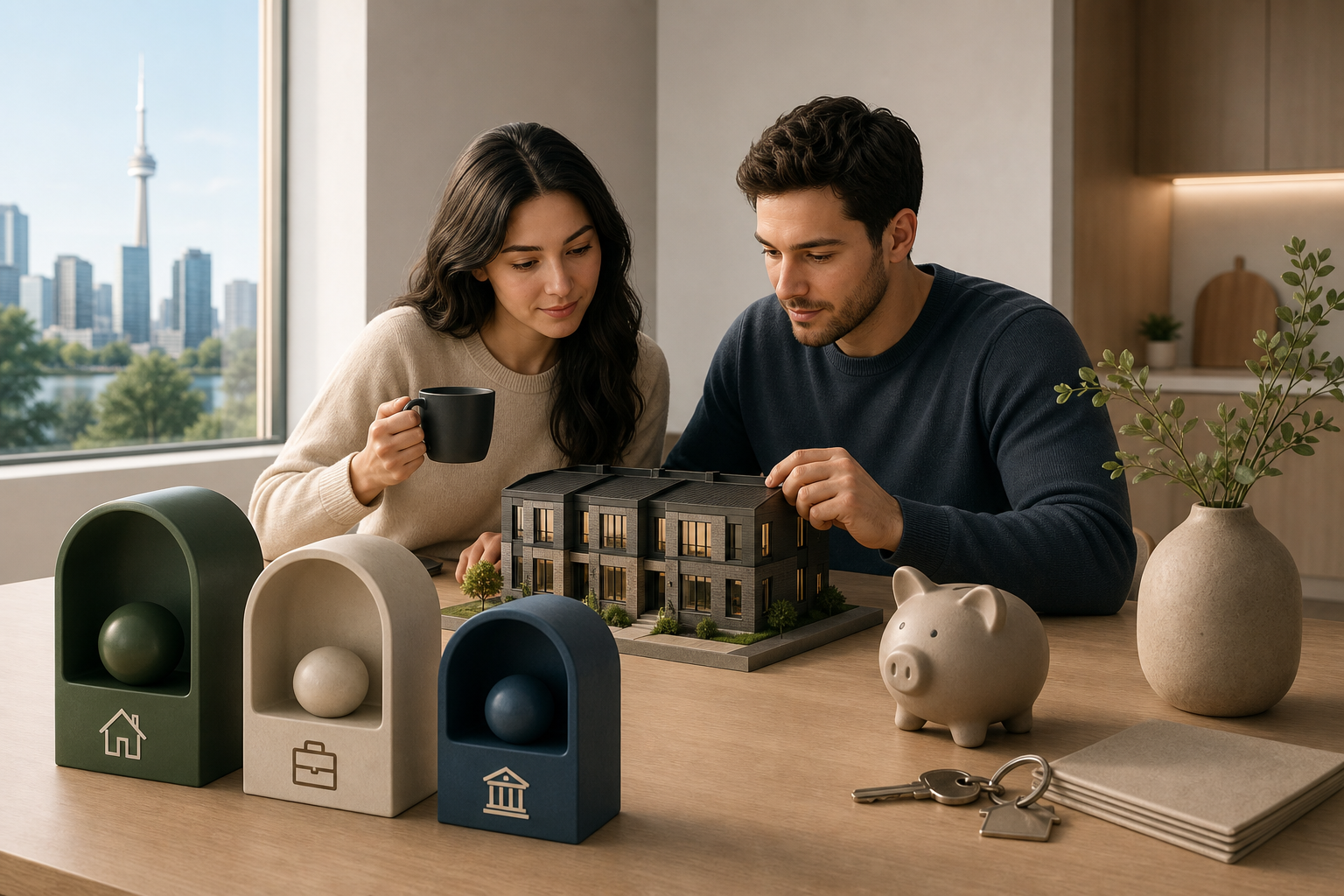
You're buying a new-build townhouse in Barrie for $620,000. The builder says you're getting "the HST rebate," but you don't know if that's baked into the sticker price or if you claim it yourself after closing. Meanwhile, your FHSA has $32,000 sitting in it, your partner's has $24,000, and you've both got RRSPs you could tap under the Home Buyers' Plan. Nobody has explained how these stack, or in what order you should actually use them.
Here's the sequence that gets you the most capital with the least tax friction.
Max the FHSA first, always
The FHSA is the only account in Canada where contributions are tax-deductible and withdrawals are tax-free. No repayment, no clawback, no future tax bill. You can contribute $8,000 per year, up to a $40,000 lifetime cap. If you're married or common-law, that's $80,000 between the two of you.
Critically, unused contribution room only carries forward for one year. If you skip 2026 and 2027, you lose $16,000 of space permanently. The RRSP lets you carry unused room forever. The FHSA does not. Open the account this year, contribute the full $8,000, and do it again next year. Use the tax refund you get from the $8,000 deduction to fund year two's contribution or to cover legal fees at closing.
Use the HBP as secondary capital, not primary
The Home Buyers' Plan lets you pull $60,000 from your RRSP, interest-free, as long as you pay it back over 15 years. A couple can access $120,000 combined.
The trap: this is a loan from your future self. If you don't repay the minimum each year, the shortfall gets added to your taxable income. That means less RRSP room going forward and a tax bill you weren't expecting. Prioritize FHSA withdrawals for the down payment. Use the HBP only if you're short after maxing the FHSA or if you need liquid cash for closing costs the lender won't roll into the mortgage.
One advantage: the HBP applies to resale homes. The FHSA and HST rebate do not. If you're buying a resale property in a hot neighborhood, the HBP might be your only tax-advantaged lever.
Confirm whether the HST rebate is assigned or claimed
Ontario's HST rebate on new builds can return up to 75% of the provincial portion of the tax, calculated on the first $400,000 of the purchase price. On a $620,000 townhouse, that's roughly $24,000 of provincial HST paid, and the rebate returns about $6,000.
Most builders "assign" the rebate to themselves and subtract it from the contract price upfront. The $620,000 you see advertised already reflects the rebate. But some builders don't assign it. In that case, you pay the full HST at closing and file for the rebate yourself afterward, which can take 6-8 weeks. Ask your lawyer or the builder's sales office which applies to your deal before you lock in financing.
If the rebate isn't assigned, budget for it. A $6,000 rebate you're expecting in two months doesn't help if you're $6,000 short at the lawyer's office today.
Claim the Ontario Land Transfer Tax refund at closing
First-time buyers in Ontario get a full refund of the provincial land transfer tax, up to $4,475. Your lawyer processes this at closing. It's automatic if you qualify, but you need to confirm you haven't owned property anywhere in the world in the last four years. That includes a condo your parents put in your name, a cabin up north, or a rental property you sold three years ago.
If you're also buying in Toronto, the city offers a separate municipal LTT refund (up to $4,475). The two stack. A first-time buyer in Toronto buying a $620,000 home gets close to $9,000 back in combined refunds.
The full math
A couple buying a $620,000 new-build in Ontario, both with maxed FHSAs and access to the HBP:
FHSA: $80,000 (tax-free)
HBP: $120,000 (must repay)
HST rebate: ~$6,000
Ontario LTT refund: $4,475
Total: $210,475 in leveraged or recovered capital. Subtract the $120,000 HBP you'll repay over 15 years, and the net benefit is north of $90,000. The title's $64,000 figure reflects a conservative single-buyer scenario using one FHSA, partial HBP access, and the rebates.
The builder won't walk you through this. Your lender might mention the FHSA. Your real estate agent will not do the tax math. Run it yourself, or pay someone who will.



You're buying a new-build townhouse in Barrie for $620,000. The builder says you're getting "the HST rebate," but you don't know if that's baked into the sticker price or if you claim it yourself after closing. Meanwhile, your FHSA has $32,000 sitting in it, your partner's has $24,000, and you've both got RRSPs you could tap under the Home Buyers' Plan. Nobody has explained how these stack, or in what order you should actually use them.
Here's the sequence that gets you the most capital with the least tax friction.
Max the FHSA first, always
The FHSA is the only account in Canada where contributions are tax-deductible and withdrawals are tax-free. No repayment, no clawback, no future tax bill. You can contribute $8,000 per year, up to a $40,000 lifetime cap. If you're married or common-law, that's $80,000 between the two of you.
Critically, unused contribution room only carries forward for one year. If you skip 2026 and 2027, you lose $16,000 of space permanently. The RRSP lets you carry unused room forever. The FHSA does not. Open the account this year, contribute the full $8,000, and do it again next year. Use the tax refund you get from the $8,000 deduction to fund year two's contribution or to cover legal fees at closing.
Use the HBP as secondary capital, not primary
The Home Buyers' Plan lets you pull $60,000 from your RRSP, interest-free, as long as you pay it back over 15 years. A couple can access $120,000 combined.
The trap: this is a loan from your future self. If you don't repay the minimum each year, the shortfall gets added to your taxable income. That means less RRSP room going forward and a tax bill you weren't expecting. Prioritize FHSA withdrawals for the down payment. Use the HBP only if you're short after maxing the FHSA or if you need liquid cash for closing costs the lender won't roll into the mortgage.
One advantage: the HBP applies to resale homes. The FHSA and HST rebate do not. If you're buying a resale property in a hot neighborhood, the HBP might be your only tax-advantaged lever.
Confirm whether the HST rebate is assigned or claimed
Ontario's HST rebate on new builds can return up to 75% of the provincial portion of the tax, calculated on the first $400,000 of the purchase price. On a $620,000 townhouse, that's roughly $24,000 of provincial HST paid, and the rebate returns about $6,000.
Most builders "assign" the rebate to themselves and subtract it from the contract price upfront. The $620,000 you see advertised already reflects the rebate. But some builders don't assign it. In that case, you pay the full HST at closing and file for the rebate yourself afterward, which can take 6-8 weeks. Ask your lawyer or the builder's sales office which applies to your deal before you lock in financing.
If the rebate isn't assigned, budget for it. A $6,000 rebate you're expecting in two months doesn't help if you're $6,000 short at the lawyer's office today.
Claim the Ontario Land Transfer Tax refund at closing
First-time buyers in Ontario get a full refund of the provincial land transfer tax, up to $4,475. Your lawyer processes this at closing. It's automatic if you qualify, but you need to confirm you haven't owned property anywhere in the world in the last four years. That includes a condo your parents put in your name, a cabin up north, or a rental property you sold three years ago.
If you're also buying in Toronto, the city offers a separate municipal LTT refund (up to $4,475). The two stack. A first-time buyer in Toronto buying a $620,000 home gets close to $9,000 back in combined refunds.
The full math
A couple buying a $620,000 new-build in Ontario, both with maxed FHSAs and access to the HBP:
Total: $210,475 in leveraged or recovered capital. Subtract the $120,000 HBP you'll repay over 15 years, and the net benefit is north of $90,000. The title's $64,000 figure reflects a conservative single-buyer scenario using one FHSA, partial HBP access, and the rebates.
The builder won't walk you through this. Your lender might mention the FHSA. Your real estate agent will not do the tax math. Run it yourself, or pay someone who will.
Read Next
Apple's Price-to-Earnings Ratio Isn't Insane, It's Ecosystem Math
Canada Lost 55,000 People This Quarter, So Why Aren't Home Prices Following?
CRA's New Billion-Dollar Ruling Program: How to Lock in Tax Certainty Before You Build
Why Porting Your 2.7% Mortgage Could Cost You $47,000 More Than Breaking It