Fifteen-plus years of BC mortgage experience, distilled into practical writing on buying, renewing, refinancing, and building wealth through real estate.
Home prices jumped 30% in these Ontario cities while Toronto stayed flat
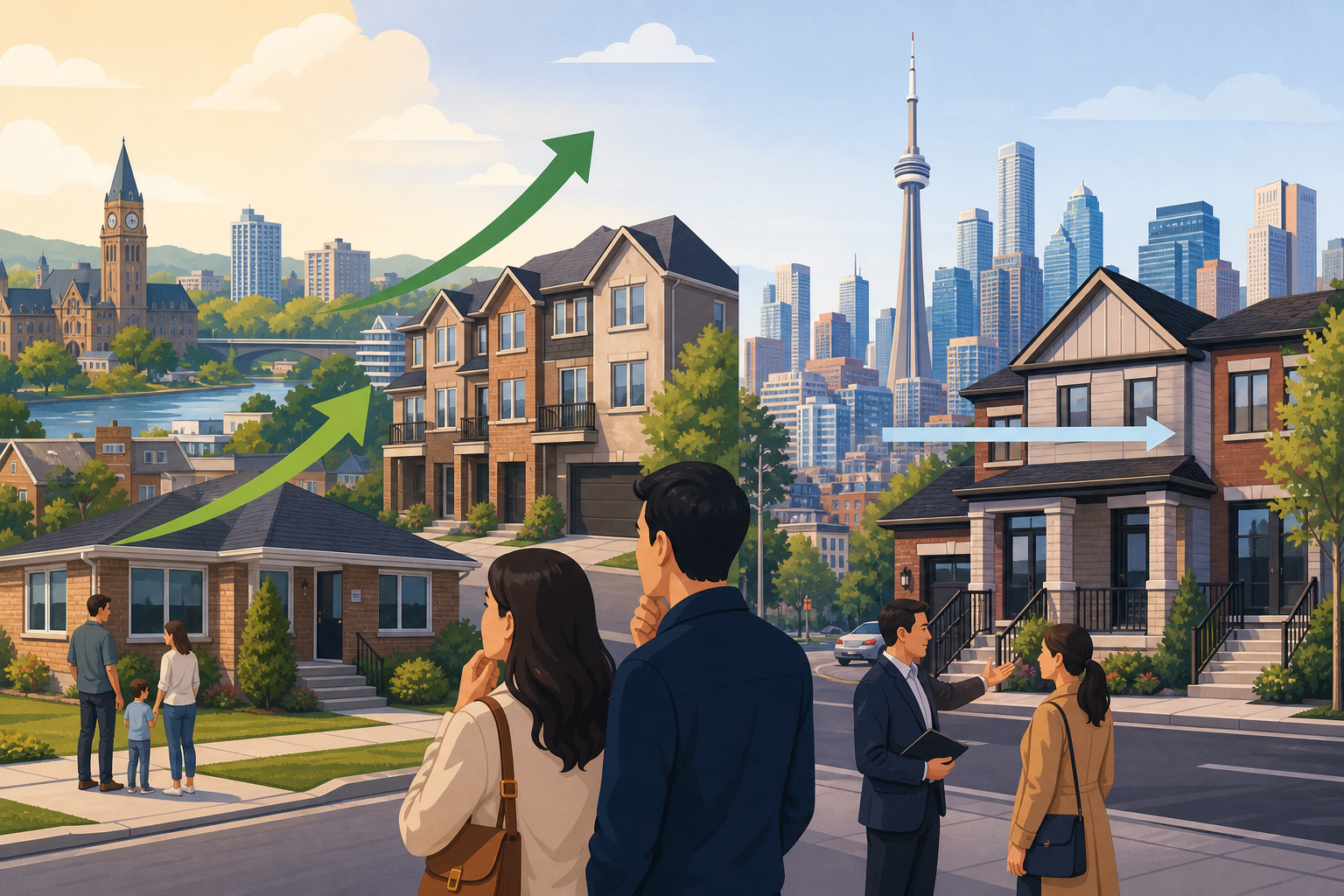
A three-bedroom bungalow in Brantford sold for $485,000 last month. The same house would have gone for $370,000 two years ago. In Barrie, townhouses that listed at $550,000 in early 2024 are now clearing $715,000. Meanwhile, a semi-detached property in Toronto's east end that sold for $1.2 million in March 2024 went for $1.19 million this spring.
The gap is not about absolute dollars. It is about velocity. Price appreciation in mid-sized Ontario cities has outpaced the Greater Toronto Area by a margin wide enough to reshape where buyers are looking and what they can afford when they get there.
Why the price divergence is structural, not cyclical
Toronto's market has entered what CMHC calls a "balanced" phase. Inventory has ticked up, bidding wars have thinned out, and the pace of sales has slowed to match pre-pandemic norms. This is not a crash. It is a normalization after years of supply constraints colliding with historically low rates.
The mid-sized cities seeing 25% to 30% gains over the past 24 months are responding to a different force: absorption of displaced demand. Buyers who were priced out of Toronto and cannot stomach a two-hour commute are moving to Kitchener, Guelph, London, and Barrie. These are not bedroom communities in the traditional sense. They are cities with their own employment bases, universities, and infrastructure. What they did not have until recently was the kind of price pressure that comes from being the next logical step down the affordability ladder.
The math is straightforward. A household that qualifies for a $700,000 mortgage in Toronto can buy a starter home in the city's outer suburbs if they are lucky. The same household can buy a detached house with a yard in Brantford or St. Catharines. The stress test does not care where you live. It cares what you can carry. When Toronto prices stop climbing but your qualifying amount stays fixed, the rational move is to buy more house somewhere else.
The policy angle no one is talking about
Provincial changes to density zoning have had almost zero impact on these mid-sized markets because the supply problem there is not zoning. It is construction throughput. Builders cannot frame houses fast enough to meet the current pace of in-migration, and material costs remain elevated. The result is a market where demand is being met by existing stock, which drives up resale prices faster than new builds can moderate them.
This is the opposite of Toronto, where new condo supply has started to soften prices in specific pockets. The 905 suburbs are seeing something closer to equilibrium. The cities an hour beyond that are seeing a gold rush.
What this means for first-time buyers in 2026
If you are trying to enter the market today, the calculus has flipped. Waiting for Toronto prices to drop further might save you 3% on the purchase price. Moving to a secondary market where prices are still climbing costs you that gain and then some if you delay. The window where Guelph or Barrie felt like a bargain relative to Toronto has closed. They are now expensive in their own right, just less expensive than the alternative.
The other shift: mortgage rates have stopped being the story. Fixed rates in the high 4% range are the floor, and buyers have accepted it. The Bank of Canada is not cutting aggressively, and bond markets are not pricing in a return to 2%. What is driving decisions now is not the rate. It is the payment relative to rent, and in most of these fast-growing cities, the gap has tightened to the point where ownership makes sense if you plan to stay five years.
The velocity gap will eventually narrow. It always does. But the households moving to these cities this year are locking in at prices that reflect the current surge, not the future stabilization. That is the trade-off.



A three-bedroom bungalow in Brantford sold for $485,000 last month. The same house would have gone for $370,000 two years ago. In Barrie, townhouses that listed at $550,000 in early 2024 are now clearing $715,000. Meanwhile, a semi-detached property in Toronto's east end that sold for $1.2 million in March 2024 went for $1.19 million this spring.
The gap is not about absolute dollars. It is about velocity. Price appreciation in mid-sized Ontario cities has outpaced the Greater Toronto Area by a margin wide enough to reshape where buyers are looking and what they can afford when they get there.
Why the price divergence is structural, not cyclical
Toronto's market has entered what CMHC calls a "balanced" phase. Inventory has ticked up, bidding wars have thinned out, and the pace of sales has slowed to match pre-pandemic norms. This is not a crash. It is a normalization after years of supply constraints colliding with historically low rates.
The mid-sized cities seeing 25% to 30% gains over the past 24 months are responding to a different force: absorption of displaced demand. Buyers who were priced out of Toronto and cannot stomach a two-hour commute are moving to Kitchener, Guelph, London, and Barrie. These are not bedroom communities in the traditional sense. They are cities with their own employment bases, universities, and infrastructure. What they did not have until recently was the kind of price pressure that comes from being the next logical step down the affordability ladder.
The math is straightforward. A household that qualifies for a $700,000 mortgage in Toronto can buy a starter home in the city's outer suburbs if they are lucky. The same household can buy a detached house with a yard in Brantford or St. Catharines. The stress test does not care where you live. It cares what you can carry. When Toronto prices stop climbing but your qualifying amount stays fixed, the rational move is to buy more house somewhere else.
The policy angle no one is talking about
Provincial changes to density zoning have had almost zero impact on these mid-sized markets because the supply problem there is not zoning. It is construction throughput. Builders cannot frame houses fast enough to meet the current pace of in-migration, and material costs remain elevated. The result is a market where demand is being met by existing stock, which drives up resale prices faster than new builds can moderate them.
This is the opposite of Toronto, where new condo supply has started to soften prices in specific pockets. The 905 suburbs are seeing something closer to equilibrium. The cities an hour beyond that are seeing a gold rush.
What this means for first-time buyers in 2026
If you are trying to enter the market today, the calculus has flipped. Waiting for Toronto prices to drop further might save you 3% on the purchase price. Moving to a secondary market where prices are still climbing costs you that gain and then some if you delay. The window where Guelph or Barrie felt like a bargain relative to Toronto has closed. They are now expensive in their own right, just less expensive than the alternative.
The other shift: mortgage rates have stopped being the story. Fixed rates in the high 4% range are the floor, and buyers have accepted it. The Bank of Canada is not cutting aggressively, and bond markets are not pricing in a return to 2%. What is driving decisions now is not the rate. It is the payment relative to rent, and in most of these fast-growing cities, the gap has tightened to the point where ownership makes sense if you plan to stay five years.
The velocity gap will eventually narrow. It always does. But the households moving to these cities this year are locking in at prices that reflect the current surge, not the future stabilization. That is the trade-off.
Read Next
Apple's Price-to-Earnings Ratio Isn't Insane, It's Ecosystem Math
Canada Lost 55,000 People This Quarter, So Why Aren't Home Prices Following?
CRA's New Billion-Dollar Ruling Program: How to Lock in Tax Certainty Before You Build
Why Porting Your 2.7% Mortgage Could Cost You $47,000 More Than Breaking It