Fifteen-plus years of BC mortgage experience, distilled into practical writing on buying, renewing, refinancing, and building wealth through real estate.
A 34% Weekly Gain Looks Like the Start, Not the Finish
Hammond Power Solutions posted preliminary quarterly results Tuesday, and by Friday the stock had climbed 34%. The transformer manufacturer trades at 16 times forward earnings. The question isn't whether that's expensive. The question is whether the multiple captures what's actually happening in the physical infrastructure layer of the data center buildout.
Most coverage of AI spending focuses on chips and cloud services. The real bottleneck is sitting upstream in substations and utility vaults. Every GPU cluster running inference models needs transformers to step down grid voltage for server racks. Every hyperscale data center under construction in Canada and the northern United States is competing for the same constrained supply of industrial electrical equipment. Hammond makes the hardware that keeps the servers from melting. They're not a tech stock. They're the picks-and-shovels play that makes tech stocks possible.
The preliminary numbers that drove the jump weren't guidance, they were concrete demand visibility stretching into 2027. Order books for industrial transformers are running six to nine months out, not the typical eight to twelve weeks. That's not a quarterly story. It's structural.
The LifeCo Turn Nobody Expected
While Hammond was running, CIBC Capital Markets published a note recommending Canadian insurance companies over the Big Six banks. The logic isn't complicated. Life insurers hold long-duration liabilities matched against fixed-income portfolios. When rates stay elevated, the spread widens. Banks, meanwhile, are provisioning more for consumer loan losses and watching mortgage originations slow to a crawl as Canadians choose renewals over new purchases.
The yield gap between lifecos and banks has narrowed to roughly 50 basis points. Great-West Lifeco and Manulife both sit in the low-5% dividend range. Royal Bank and TD pay slightly more but carry heavier exposure to a consumer balance sheet that's levered 1.8-to-1 on average debt-to-income. CIBC's call isn't a bet against banks, it's an acknowledgment that the insurance side of the ledger handles higher-for-longer better than the lending side does.
This would be unremarkable in a normal cycle. What makes it sharp is the timing. Canadian retail investors have spent two decades treating the banks as the dividend anchor in every RRSP. The idea that Sun Life might be the better risk-adjusted hold for the next eighteen months cuts against muscle memory.
Energy Price Targets Move Before the Print
Scotiabank and CIBC both raised targets on several Canadian energy producers ahead of second-quarter earnings, scheduled to drop in late July and early August. The revisions weren't dramatic, mostly $2 to $4 increases on names like Canadian Natural Resources and Cenovus, but they signal something more interesting than bullishness. WTI crude has been trading in a tight $75 to $85 band for three months. The Street is pricing discipline, not a price surge.
Free cash flow for the Canadian energy complex is running at a level that supports both dividends and buybacks without requiring $90 oil. That's new. As recently as 2019, the model required $75 as baseline and $85 to really work. Leaner capital programs and better per-barrel economics mean the margin for error has widened. The price target adjustments reflect that structural shift more than any near-term commodity call.
The Broadening Nobody Wanted to Believe
Put the three moves together and you get a market that's stopped waiting for the TSX 60 to do all the work. Hammond Power is a $1.2 billion market cap. It's not a giant. The fact that it can move 34% in a week on operational results, not speculation, suggests capital is hunting beyond the usual dividend aristocrats.
The TSX has spent years as a two-sector show: financials and energy, with occasional guest appearances from utilities and telecoms. A transformer manufacturer running because data centers need physical infrastructure is a different script. So is an institutional desk telling clients to rotate out of banks into insurance. The composition is shifting faster than the index level suggests.


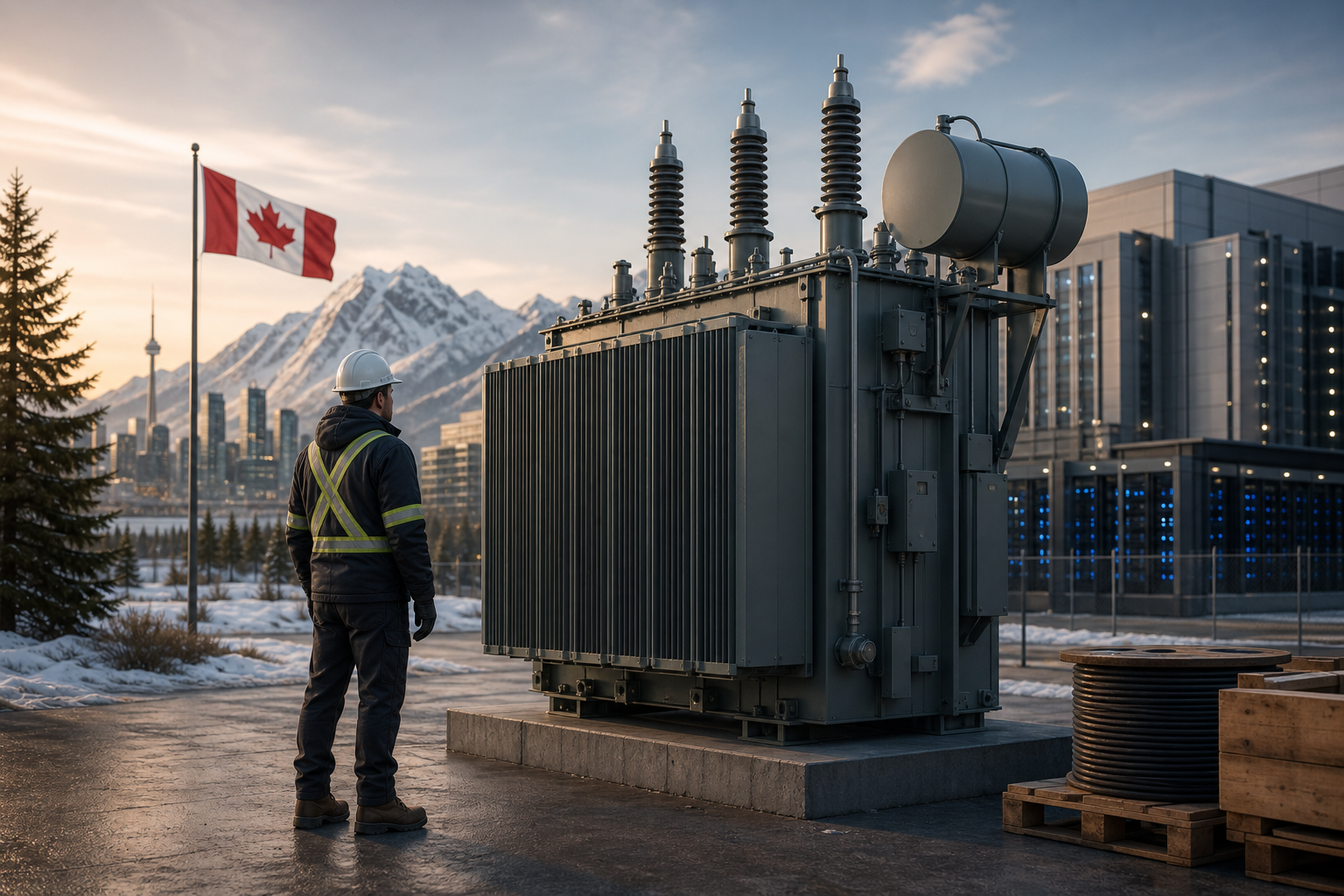

Hammond Power Solutions posted preliminary quarterly results Tuesday, and by Friday the stock had climbed 34%. The transformer manufacturer trades at 16 times forward earnings. The question isn't whether that's expensive. The question is whether the multiple captures what's actually happening in the physical infrastructure layer of the data center buildout.
Most coverage of AI spending focuses on chips and cloud services. The real bottleneck is sitting upstream in substations and utility vaults. Every GPU cluster running inference models needs transformers to step down grid voltage for server racks. Every hyperscale data center under construction in Canada and the northern United States is competing for the same constrained supply of industrial electrical equipment. Hammond makes the hardware that keeps the servers from melting. They're not a tech stock. They're the picks-and-shovels play that makes tech stocks possible.
The preliminary numbers that drove the jump weren't guidance, they were concrete demand visibility stretching into 2027. Order books for industrial transformers are running six to nine months out, not the typical eight to twelve weeks. That's not a quarterly story. It's structural.
The LifeCo Turn Nobody Expected
While Hammond was running, CIBC Capital Markets published a note recommending Canadian insurance companies over the Big Six banks. The logic isn't complicated. Life insurers hold long-duration liabilities matched against fixed-income portfolios. When rates stay elevated, the spread widens. Banks, meanwhile, are provisioning more for consumer loan losses and watching mortgage originations slow to a crawl as Canadians choose renewals over new purchases.
The yield gap between lifecos and banks has narrowed to roughly 50 basis points. Great-West Lifeco and Manulife both sit in the low-5% dividend range. Royal Bank and TD pay slightly more but carry heavier exposure to a consumer balance sheet that's levered 1.8-to-1 on average debt-to-income. CIBC's call isn't a bet against banks, it's an acknowledgment that the insurance side of the ledger handles higher-for-longer better than the lending side does.
This would be unremarkable in a normal cycle. What makes it sharp is the timing. Canadian retail investors have spent two decades treating the banks as the dividend anchor in every RRSP. The idea that Sun Life might be the better risk-adjusted hold for the next eighteen months cuts against muscle memory.
Energy Price Targets Move Before the Print
Scotiabank and CIBC both raised targets on several Canadian energy producers ahead of second-quarter earnings, scheduled to drop in late July and early August. The revisions weren't dramatic, mostly $2 to $4 increases on names like Canadian Natural Resources and Cenovus, but they signal something more interesting than bullishness. WTI crude has been trading in a tight $75 to $85 band for three months. The Street is pricing discipline, not a price surge.
Free cash flow for the Canadian energy complex is running at a level that supports both dividends and buybacks without requiring $90 oil. That's new. As recently as 2019, the model required $75 as baseline and $85 to really work. Leaner capital programs and better per-barrel economics mean the margin for error has widened. The price target adjustments reflect that structural shift more than any near-term commodity call.
The Broadening Nobody Wanted to Believe
Put the three moves together and you get a market that's stopped waiting for the TSX 60 to do all the work. Hammond Power is a $1.2 billion market cap. It's not a giant. The fact that it can move 34% in a week on operational results, not speculation, suggests capital is hunting beyond the usual dividend aristocrats.
The TSX has spent years as a two-sector show: financials and energy, with occasional guest appearances from utilities and telecoms. A transformer manufacturer running because data centers need physical infrastructure is a different script. So is an institutional desk telling clients to rotate out of banks into insurance. The composition is shifting faster than the index level suggests.
Read Next
Apple's Price-to-Earnings Ratio Isn't Insane, It's Ecosystem Math
Canada Lost 55,000 People This Quarter, So Why Aren't Home Prices Following?
CRA's New Billion-Dollar Ruling Program: How to Lock in Tax Certainty Before You Build
Why Porting Your 2.7% Mortgage Could Cost You $47,000 More Than Breaking It