Fifteen-plus years of BC mortgage experience, distilled into practical writing on buying, renewing, refinancing, and building wealth through real estate.
7 Strategies That Cut Canada's 4.4-Year Down Payment Timeline to 24 Months
Maya and Jordan closed on their first homes in Metro Vancouver seven months apart. Maya's timeline from zero savings to keys: 23 months. Jordan's: 54 months. Same starting salaries, same employer, same rental costs within $200. The difference wasn't luck or inheritance, Maya worked a system Jordan didn't know existed.
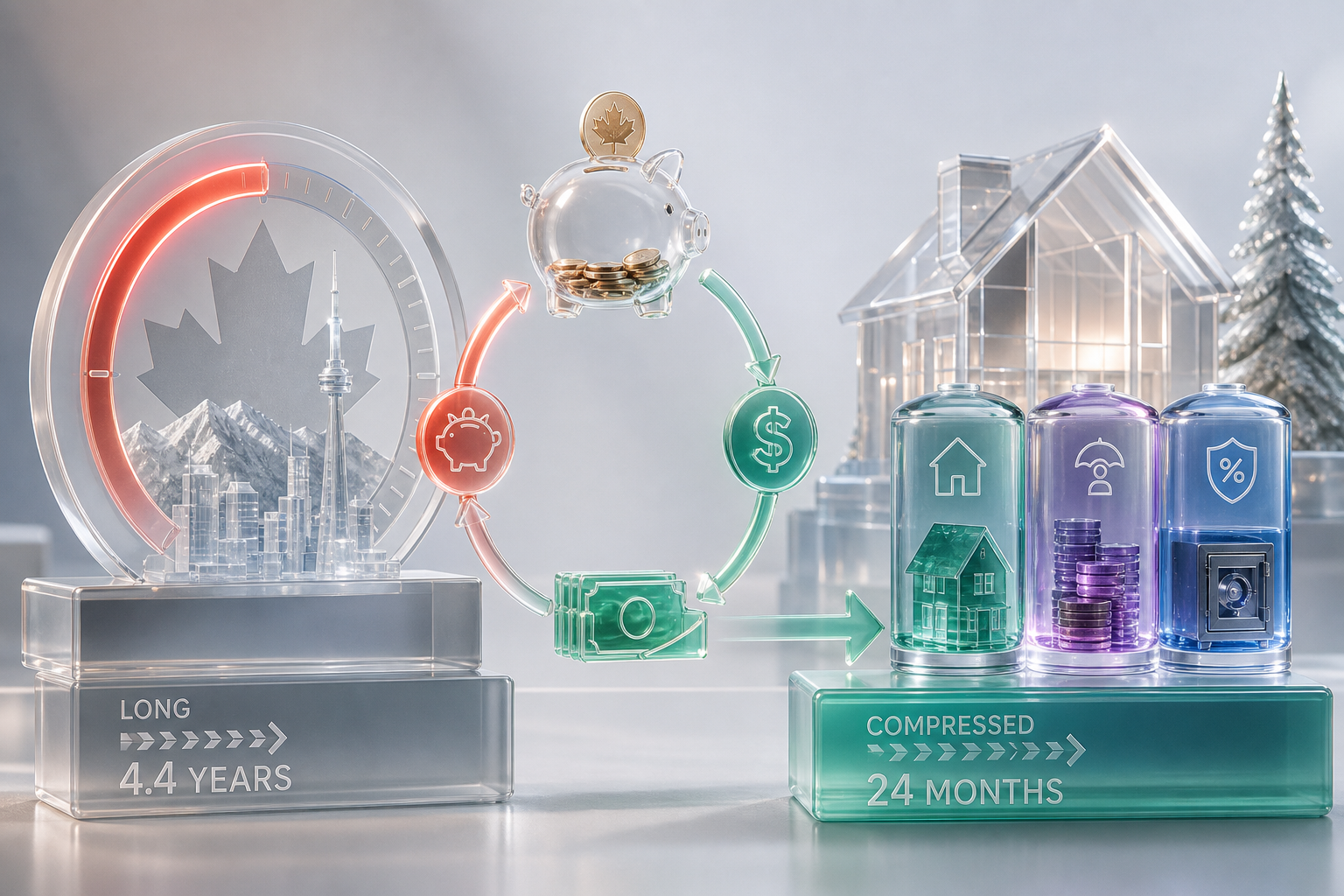
Here's how to compress Canada's 4.4-year average into something closer to two years.
1. Open an FHSA on January 2, contribute $8,000, file for the refund by March
The First Home Savings Account gives you an immediate tax deduction on contributions. At a 29.65% marginal rate (the combined federal-provincial bracket for $60,000 of income in Ontario), an $8,000 contribution returns roughly $2,370 at tax time. Contribute in early January. File your return in March. Reinvest that refund into the same FHSA or a high-interest savings account by April. You've just created a second savings cycle in year one instead of waiting until year two.
Most people contribute once a year and pocket the refund as spending money. The flywheel move is to treat the refund as forced savings and loop it back immediately.
2. Automate transfers on the day your paycheque lands, not the day before rent is due
Set your transfer for the same day income hits your account. If you're paid biweekly, $307 per paycheque becomes $8,000 annually without a single manual decision. Waiting until "the end of the month" means the money has already leaked into groceries, Uber Eats, and spontaneous weekend plans.
Treat your down payment like you treat your cell phone bill: non-negotiable, first in line, automated.
3. Stack the FHSA with the RRSP Home Buyers' Plan for a $100,000 combined ceiling
The FHSA lifetime cap is $40,000. If you're part of a couple, that's $80,000 combined, tax-free in and tax-free out. Add the Home Buyers' Plan (HBP), which lets you withdraw $60,000 from your RRSP per person without penalty, and a couple can pull $200,000 toward a down payment. Even solo, the FHSA-HBP stack gives you $100,000 in shielded room.
The HBP requires repayment over 15 years, but the FHSA does not. Prioritize the FHSA first, then layer in RRSP contributions if you're already maxing the FHSA annually.
4. Earmark 100% of non-primary income into a separate account with zero access
Freelance gigs, year-end bonuses, tax refunds, birthday money from relatives. All of it goes into a dedicated account with no debit card. Lifestyle creep happens when "extra" money feels like spending permission. The couples who hit 24 months in the CMHC data didn't treat side income as disposable, they treated it as the down payment fund's turbo button.
A $4,000 bonus deposited into your main account becomes dinner out and a long weekend. A $4,000 bonus auto-transferred into a locked savings account stays $4,000.
5. Research municipal and provincial down payment assistance before you write them off
Programs like the Ontario Down Payment Assistance Program or Edmonton's affordable homeownership initiatives offer interest-free loans or forgivable grants for a portion of your down payment. Most are income-tested and require you to be a first-time buyer, but the eligibility bands are wider than people assume.
A $20,000 municipal match on a 5% down payment for a $450,000 home drops your personal cash requirement from $22,500 to $2,500. These programs are underused because they're fragmented across municipalities and not advertised widely. Start with your city's housing department website, not Google.
6. Lock savings into 1-year GICs once you're within 18 months of your target date
When you're two years out, inflation risk and opportunity cost matter. When you're 18 months out, protecting the principal matters more. A 5.25% GIC (available from most Canadian banks as of mid-2026) on $30,000 returns $1,575 with zero volatility. The stock market might beat that, or it might drop 11% the week you're ready to make an offer.
The trade-off flips once your timeline gets concrete. Growth gives way to certainty.
7. Cut one recurring expense that you wouldn't miss in a blackout test
If your internet went down for three days, which subscriptions would you not think about? Cancel those. The average Canadian household carries $62 per month in unused or underused subscriptions (streaming services, meal kits, app subscriptions). That's $744 annually, or $1,488 over two years.
The "blackout test" is sharper than asking what you "should" cancel. It isolates what you actually use from what you're just paying for out of habit.
The 4.4-year average includes people who saved casually, people who restarted after setbacks, and people who didn't know these vehicles existed. The 24-month path requires deliberate sequencing and automation, not heroic income. Maya's timeline worked because she opened the FHSA in year one, automated in month two, and stacked accounts by month six. Jordan saved the same dollar amount but did it in his chequing account with no tax shield and no system.
Same effort. Different structure. Twenty-seven fewer months.



Maya and Jordan closed on their first homes in Metro Vancouver seven months apart. Maya's timeline from zero savings to keys: 23 months. Jordan's: 54 months. Same starting salaries, same employer, same rental costs within $200. The difference wasn't luck or inheritance, Maya worked a system Jordan didn't know existed.
Here's how to compress Canada's 4.4-year average into something closer to two years.
1. Open an FHSA on January 2, contribute $8,000, file for the refund by March
The First Home Savings Account gives you an immediate tax deduction on contributions. At a 29.65% marginal rate (the combined federal-provincial bracket for $60,000 of income in Ontario), an $8,000 contribution returns roughly $2,370 at tax time. Contribute in early January. File your return in March. Reinvest that refund into the same FHSA or a high-interest savings account by April. You've just created a second savings cycle in year one instead of waiting until year two.
Most people contribute once a year and pocket the refund as spending money. The flywheel move is to treat the refund as forced savings and loop it back immediately.
2. Automate transfers on the day your paycheque lands, not the day before rent is due
Set your transfer for the same day income hits your account. If you're paid biweekly, $307 per paycheque becomes $8,000 annually without a single manual decision. Waiting until "the end of the month" means the money has already leaked into groceries, Uber Eats, and spontaneous weekend plans.
Treat your down payment like you treat your cell phone bill: non-negotiable, first in line, automated.
3. Stack the FHSA with the RRSP Home Buyers' Plan for a $100,000 combined ceiling
The FHSA lifetime cap is $40,000. If you're part of a couple, that's $80,000 combined, tax-free in and tax-free out. Add the Home Buyers' Plan (HBP), which lets you withdraw $60,000 from your RRSP per person without penalty, and a couple can pull $200,000 toward a down payment. Even solo, the FHSA-HBP stack gives you $100,000 in shielded room.
The HBP requires repayment over 15 years, but the FHSA does not. Prioritize the FHSA first, then layer in RRSP contributions if you're already maxing the FHSA annually.
4. Earmark 100% of non-primary income into a separate account with zero access
Freelance gigs, year-end bonuses, tax refunds, birthday money from relatives. All of it goes into a dedicated account with no debit card. Lifestyle creep happens when "extra" money feels like spending permission. The couples who hit 24 months in the CMHC data didn't treat side income as disposable, they treated it as the down payment fund's turbo button.
A $4,000 bonus deposited into your main account becomes dinner out and a long weekend. A $4,000 bonus auto-transferred into a locked savings account stays $4,000.
5. Research municipal and provincial down payment assistance before you write them off
Programs like the Ontario Down Payment Assistance Program or Edmonton's affordable homeownership initiatives offer interest-free loans or forgivable grants for a portion of your down payment. Most are income-tested and require you to be a first-time buyer, but the eligibility bands are wider than people assume.
A $20,000 municipal match on a 5% down payment for a $450,000 home drops your personal cash requirement from $22,500 to $2,500. These programs are underused because they're fragmented across municipalities and not advertised widely. Start with your city's housing department website, not Google.
6. Lock savings into 1-year GICs once you're within 18 months of your target date
When you're two years out, inflation risk and opportunity cost matter. When you're 18 months out, protecting the principal matters more. A 5.25% GIC (available from most Canadian banks as of mid-2026) on $30,000 returns $1,575 with zero volatility. The stock market might beat that, or it might drop 11% the week you're ready to make an offer.
The trade-off flips once your timeline gets concrete. Growth gives way to certainty.
7. Cut one recurring expense that you wouldn't miss in a blackout test
If your internet went down for three days, which subscriptions would you not think about? Cancel those. The average Canadian household carries $62 per month in unused or underused subscriptions (streaming services, meal kits, app subscriptions). That's $744 annually, or $1,488 over two years.
The "blackout test" is sharper than asking what you "should" cancel. It isolates what you actually use from what you're just paying for out of habit.
The 4.4-year average includes people who saved casually, people who restarted after setbacks, and people who didn't know these vehicles existed. The 24-month path requires deliberate sequencing and automation, not heroic income. Maya's timeline worked because she opened the FHSA in year one, automated in month two, and stacked accounts by month six. Jordan saved the same dollar amount but did it in his chequing account with no tax shield and no system.
Same effort. Different structure. Twenty-seven fewer months.
Read Next
Apple's Price-to-Earnings Ratio Isn't Insane, It's Ecosystem Math
Canada Lost 55,000 People This Quarter, So Why Aren't Home Prices Following?
CRA's New Billion-Dollar Ruling Program: How to Lock in Tax Certainty Before You Build
Why Porting Your 2.7% Mortgage Could Cost You $47,000 More Than Breaking It