Fifteen-plus years of BC mortgage experience, distilled into practical writing on buying, renewing, refinancing, and building wealth through real estate.
Why $15/month tenant insurance can save Canadian students $2,000 in one incident
A week into January 2026, a residence floor at the University of Waterloo lost power for 11 hours after a space heater overloaded a circuit and started a small electrical fire. No one was hurt, but twelve students spent two nights in a campus hotel while the damage was assessed. The three who had tenant insurance submitted claims for hotel and meal expenses. The nine who didn't split a $1,800 bill out of pocket.
That scenario plays out in some version across Canadian campuses every semester, and most students don't know they're exposed until it happens.
The math works because the deductible isn't triggered
Most students think insurance is for stolen laptops or broken phones, items worth less than the typical $500 deductible, making a claim pointless. They're not wrong about that part. Where they're wrong is assuming that's the only coverage in the policy.
The $15/month student tenant policy includes two things that have nothing to do with your MacBook: personal liability coverage (usually $1 million minimum) and additional living expenses. The latter is what pays the hotel bill when the building floods, catches fire, or loses heat in February. There's no deductible on displacement costs in most Canadian policies. You submit receipts, the insurer cuts a cheque.
A week in a mid-tier hotel in Toronto or Vancouver runs $1,400. Add meals and you're past $2,000 before the building reopens. One incident pays for a decade of premiums.
Your parents' policy probably doesn't cover you the way you think
Roughly half of students assume they're already covered under their parents' homeowners insurance. They're partly right. Most Canadian policies extend contents coverage to a dependent child living away at school, but the sub-limit is often capped at $2,500 to $5,000. That might cover your textbooks and clothes. It won't cover a $2,800 gaming PC, a $1,200 road bike locked in the storage cage, and a semester's worth of furniture.
And the liability piece? If you start a kitchen fire that damages the unit next door, your parents' policy might respond, but only if you're listed as a dependent and still enrolled full-time. The insurer will also ask why you didn't disclose that you were living off-campus in a private rental. Gaps in disclosure void coverage faster than anything else.
The safer move: get your own policy. It runs $180 to $360 a year depending on the city and your coverage limit. You control it, you know the terms, and you're not relying on a parent's policy that was written for a suburban detached home, not a century-old walk-up with galvanized plumbing.
The liability trap: your roommate's mess, your problem
Standard tenant policies cover only the named policyholder. If your roommate leaves a candle burning and starts a fire, their insurance responds. If you don't have a policy and the landlord's insurer decides you share fault because you were home and didn't intervene, you're personally liable for your share of the building damage.
Building damage isn't $2,000. It's $20,000 or more. Landlords in Ontario and British Columbia are increasingly writing mandatory insurance clauses into leases specifically to avoid this scenario, they want every tenant independently covered so the loss doesn't land on one uninsured person who can't pay.
Even if your lease doesn't require it, assume your landlord's building insurance doesn't cover your stuff. It doesn't. His policy covers the structure. Yours covers everything inside the four walls and your legal exposure if you accidentally wreck someone else's property.
What actually matters when you're comparing policies
Ignore the sales pitch about worldwide coverage for your phone. Focus on three lines: the contents limit (start at $20,000 if you have a laptop, bike, and any furniture), the liability minimum (don't go below $1 million), and whether the payout is replacement cost or actual cash value. Replacement cost means the insurer pays what it costs to buy a new version of the item today. Actual cash value deducts depreciation, leaving you $400 short when your three-year-old laptop dies in a flood and the payout is based on its resale value, not the $1,100 it costs to replace.
Most insurers let you get a quote online in under five minutes. The ones that consistently show up cheapest for students in 2026: Square One, Sonnet, and TD. If your parents already bank with one of the big five, ask about a multi-policy discount, it's usually 10 to 15 percent.
The policy pays for itself the first time the building loses heat in winter and you're the only one on your floor who doesn't Venmo $200 for an emergency Airbnb.


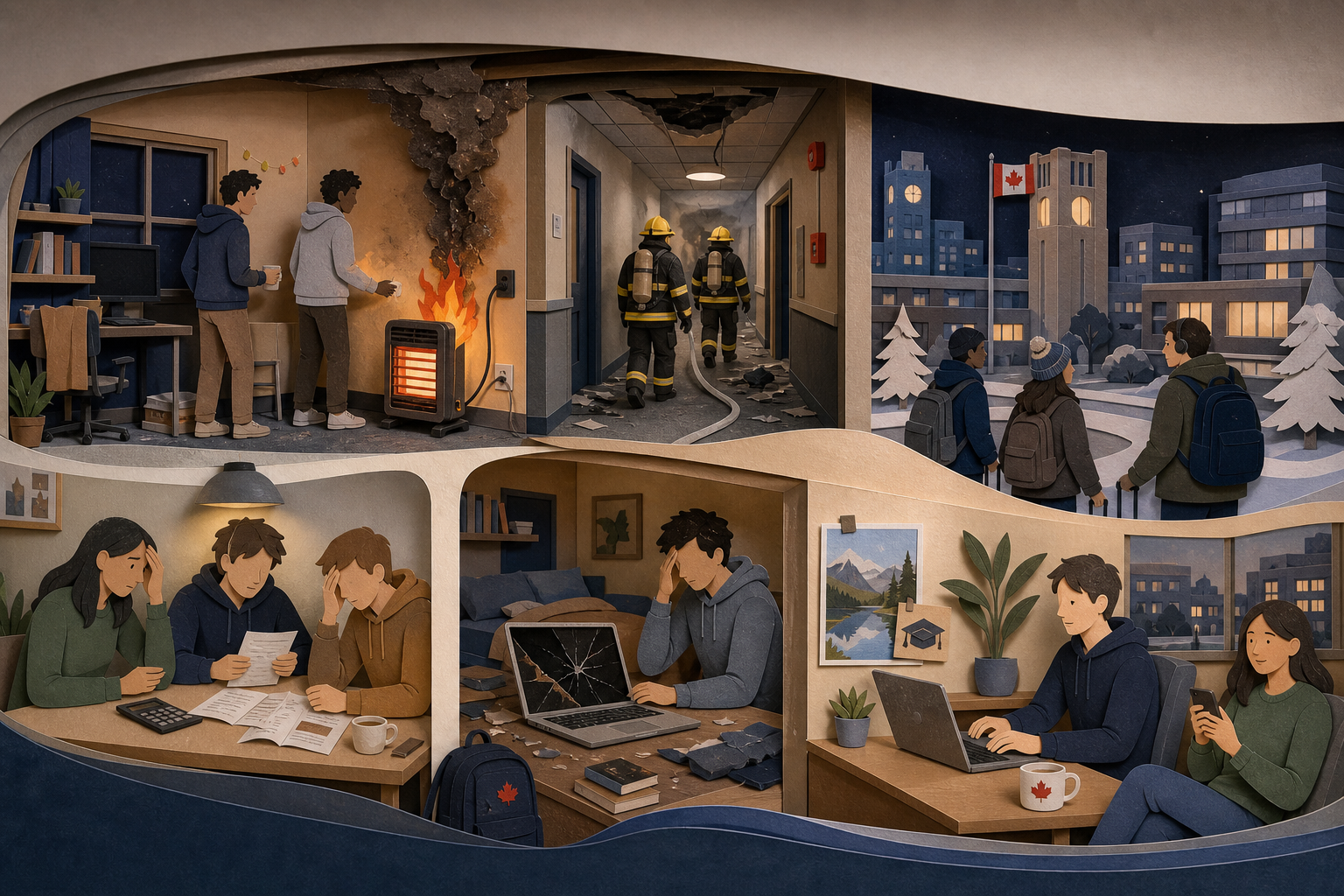

A week into January 2026, a residence floor at the University of Waterloo lost power for 11 hours after a space heater overloaded a circuit and started a small electrical fire. No one was hurt, but twelve students spent two nights in a campus hotel while the damage was assessed. The three who had tenant insurance submitted claims for hotel and meal expenses. The nine who didn't split a $1,800 bill out of pocket.
That scenario plays out in some version across Canadian campuses every semester, and most students don't know they're exposed until it happens.
The math works because the deductible isn't triggered
Most students think insurance is for stolen laptops or broken phones, items worth less than the typical $500 deductible, making a claim pointless. They're not wrong about that part. Where they're wrong is assuming that's the only coverage in the policy.
The $15/month student tenant policy includes two things that have nothing to do with your MacBook: personal liability coverage (usually $1 million minimum) and additional living expenses. The latter is what pays the hotel bill when the building floods, catches fire, or loses heat in February. There's no deductible on displacement costs in most Canadian policies. You submit receipts, the insurer cuts a cheque.
A week in a mid-tier hotel in Toronto or Vancouver runs $1,400. Add meals and you're past $2,000 before the building reopens. One incident pays for a decade of premiums.
Your parents' policy probably doesn't cover you the way you think
Roughly half of students assume they're already covered under their parents' homeowners insurance. They're partly right. Most Canadian policies extend contents coverage to a dependent child living away at school, but the sub-limit is often capped at $2,500 to $5,000. That might cover your textbooks and clothes. It won't cover a $2,800 gaming PC, a $1,200 road bike locked in the storage cage, and a semester's worth of furniture.
And the liability piece? If you start a kitchen fire that damages the unit next door, your parents' policy might respond, but only if you're listed as a dependent and still enrolled full-time. The insurer will also ask why you didn't disclose that you were living off-campus in a private rental. Gaps in disclosure void coverage faster than anything else.
The safer move: get your own policy. It runs $180 to $360 a year depending on the city and your coverage limit. You control it, you know the terms, and you're not relying on a parent's policy that was written for a suburban detached home, not a century-old walk-up with galvanized plumbing.
The liability trap: your roommate's mess, your problem
Standard tenant policies cover only the named policyholder. If your roommate leaves a candle burning and starts a fire, their insurance responds. If you don't have a policy and the landlord's insurer decides you share fault because you were home and didn't intervene, you're personally liable for your share of the building damage.
Building damage isn't $2,000. It's $20,000 or more. Landlords in Ontario and British Columbia are increasingly writing mandatory insurance clauses into leases specifically to avoid this scenario, they want every tenant independently covered so the loss doesn't land on one uninsured person who can't pay.
Even if your lease doesn't require it, assume your landlord's building insurance doesn't cover your stuff. It doesn't. His policy covers the structure. Yours covers everything inside the four walls and your legal exposure if you accidentally wreck someone else's property.
What actually matters when you're comparing policies
Ignore the sales pitch about worldwide coverage for your phone. Focus on three lines: the contents limit (start at $20,000 if you have a laptop, bike, and any furniture), the liability minimum (don't go below $1 million), and whether the payout is replacement cost or actual cash value. Replacement cost means the insurer pays what it costs to buy a new version of the item today. Actual cash value deducts depreciation, leaving you $400 short when your three-year-old laptop dies in a flood and the payout is based on its resale value, not the $1,100 it costs to replace.
Most insurers let you get a quote online in under five minutes. The ones that consistently show up cheapest for students in 2026: Square One, Sonnet, and TD. If your parents already bank with one of the big five, ask about a multi-policy discount, it's usually 10 to 15 percent.
The policy pays for itself the first time the building loses heat in winter and you're the only one on your floor who doesn't Venmo $200 for an emergency Airbnb.
Read Next
Canada Lost 55,000 People This Quarter, So Why Aren't Home Prices Following?
CRA's New Billion-Dollar Ruling Program: How to Lock in Tax Certainty Before You Build
Why Porting Your 2.7% Mortgage Could Cost You $47,000 More Than Breaking It
Why Your Mortgage Renewal Is Making Crypto Look Smart (And What That Tells You)