Fifteen-plus years of BC mortgage experience, distilled into practical writing on buying, renewing, refinancing, and building wealth through real estate.
Trump's Tariff Threat Just Turned the Bank of Canada's Rate Pause Into a Question Mark
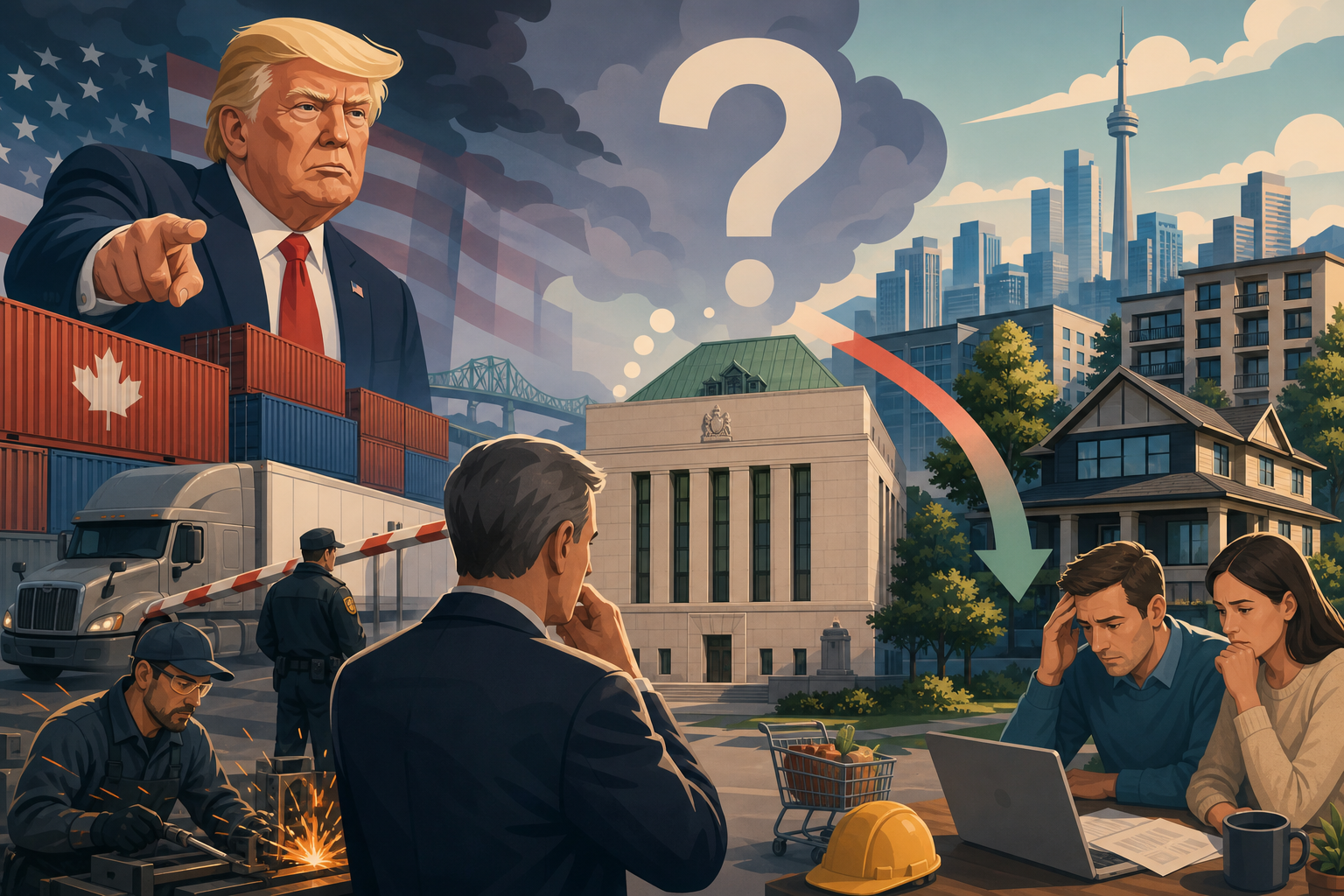
The Bank of Canada's overnight rate has sat at 4.25% since March, and most economists had penciled in a stable 2026. BMO Capital Markets just rewrote that forecast with a single variable: what happens if Trump wins in November and follows through on the universal baseline tariff he's been promising since the primaries.
The math is straightforward. Roughly 75% of Canadian exports cross the U.S. border. A 10% tariff, Trump's baseline proposal, acts as a direct tax on Canadian manufacturing, energy, and agriculture. The immediate effect is inflationary: goods cost more. But the second-order effect, the one BMO is betting on, is deflationary. When Canadian exporters lose margin or volume, corporate spending contracts. When business investment drops, employment softens. When employment softens, consumer demand follows. That sequence gives the Bank of Canada room to cut rates, possibly as soon as Q1 2027.
The Two-Stage Shock
Trade wars hit central banks in phases. Stage one is the price spike. Tariffs raise the cost of cross-border goods, which shows up in CPI. If inflation jumps from 2% to 3% in a matter of months, the Bank of Canada's mandate is to hold rates steady or even raise them. Stage two is the demand collapse. Firms that can't absorb the tariff cost lay off workers or freeze hiring. Consumers who were already stretched pull back. Inflation falls, often sharply, because fewer people are buying anything.
BMO's forecast hinges on stage two outweighing stage one. If the tariff shock is broad and sustained, not a negotiating tactic that gets walked back in 90 days, the deflationary pressure will dominate. At that point, the Bank of Canada's only lever is the overnight rate, and the direction is down.
The USMCA review scheduled for late 2026 makes this scenario more than speculative. That sunset clause creates a natural moment for the U.S. to demand concessions or impose tariffs as leverage. Canada has historically negotiated exemptions, particularly for energy. But Trump's rhetoric has framed universal tariffs as non-negotiable baseline policy, not sector-specific retaliation. If that framing holds, exemptions may not materialize.
The Currency Trap
Cutting rates to support a slowing economy has a side effect: it weakens the Canadian dollar. The loonie is already trading in the $0.71 to $0.73 range against the USD. A trade war that forces rate cuts could push it below $0.70. A weaker currency makes imports more expensive, food, electronics, anything priced in USD, which reintroduces inflationary pressure just as the Bank of Canada is trying to ease. That creates a policy bind. Cut rates and the currency weakens, importing inflation. Hold rates and the economy contracts further.
This is not hypothetical hand-wringing. During the 2018 steel and aluminum tariff period, the Bank of Canada cited trade uncertainty as a drag on business investment in three consecutive Monetary Policy Reports. Investment growth in 2019 came in at 1.2%, well below the 3.1% forecast. The current scenario is broader. A universal tariff doesn't just hit two sectors. It hits the entire export base.
What It Means for Borrowers
Variable-rate mortgage holders have been waiting for relief since the Bank of Canada paused hikes in early 2023. The current pause has kept the overnight rate stable but hasn't triggered cuts. A tariff-induced slowdown could finally move the needle, but not in the way most borrowers are hoping. Rate cuts driven by economic weakness mean lower borrowing costs alongside a weaker job market and slower wage growth. The mortgage gets cheaper, but so does everything else.
BMO's base case still assumes no cuts in 2026. But the base case now includes a footnote: that assumes trade relations don't deteriorate. If Trump wins and implements what he's promised, the footnote becomes the forecast.



The Bank of Canada's overnight rate has sat at 4.25% since March, and most economists had penciled in a stable 2026. BMO Capital Markets just rewrote that forecast with a single variable: what happens if Trump wins in November and follows through on the universal baseline tariff he's been promising since the primaries.
The math is straightforward. Roughly 75% of Canadian exports cross the U.S. border. A 10% tariff, Trump's baseline proposal, acts as a direct tax on Canadian manufacturing, energy, and agriculture. The immediate effect is inflationary: goods cost more. But the second-order effect, the one BMO is betting on, is deflationary. When Canadian exporters lose margin or volume, corporate spending contracts. When business investment drops, employment softens. When employment softens, consumer demand follows. That sequence gives the Bank of Canada room to cut rates, possibly as soon as Q1 2027.
The Two-Stage Shock
Trade wars hit central banks in phases. Stage one is the price spike. Tariffs raise the cost of cross-border goods, which shows up in CPI. If inflation jumps from 2% to 3% in a matter of months, the Bank of Canada's mandate is to hold rates steady or even raise them. Stage two is the demand collapse. Firms that can't absorb the tariff cost lay off workers or freeze hiring. Consumers who were already stretched pull back. Inflation falls, often sharply, because fewer people are buying anything.
BMO's forecast hinges on stage two outweighing stage one. If the tariff shock is broad and sustained, not a negotiating tactic that gets walked back in 90 days, the deflationary pressure will dominate. At that point, the Bank of Canada's only lever is the overnight rate, and the direction is down.
The USMCA review scheduled for late 2026 makes this scenario more than speculative. That sunset clause creates a natural moment for the U.S. to demand concessions or impose tariffs as leverage. Canada has historically negotiated exemptions, particularly for energy. But Trump's rhetoric has framed universal tariffs as non-negotiable baseline policy, not sector-specific retaliation. If that framing holds, exemptions may not materialize.
The Currency Trap
Cutting rates to support a slowing economy has a side effect: it weakens the Canadian dollar. The loonie is already trading in the $0.71 to $0.73 range against the USD. A trade war that forces rate cuts could push it below $0.70. A weaker currency makes imports more expensive, food, electronics, anything priced in USD, which reintroduces inflationary pressure just as the Bank of Canada is trying to ease. That creates a policy bind. Cut rates and the currency weakens, importing inflation. Hold rates and the economy contracts further.
This is not hypothetical hand-wringing. During the 2018 steel and aluminum tariff period, the Bank of Canada cited trade uncertainty as a drag on business investment in three consecutive Monetary Policy Reports. Investment growth in 2019 came in at 1.2%, well below the 3.1% forecast. The current scenario is broader. A universal tariff doesn't just hit two sectors. It hits the entire export base.
What It Means for Borrowers
Variable-rate mortgage holders have been waiting for relief since the Bank of Canada paused hikes in early 2023. The current pause has kept the overnight rate stable but hasn't triggered cuts. A tariff-induced slowdown could finally move the needle, but not in the way most borrowers are hoping. Rate cuts driven by economic weakness mean lower borrowing costs alongside a weaker job market and slower wage growth. The mortgage gets cheaper, but so does everything else.
BMO's base case still assumes no cuts in 2026. But the base case now includes a footnote: that assumes trade relations don't deteriorate. If Trump wins and implements what he's promised, the footnote becomes the forecast.
Read Next
Canada Lost 55,000 People This Quarter, So Why Aren't Home Prices Following?
CRA's New Billion-Dollar Ruling Program: How to Lock in Tax Certainty Before You Build
Why Porting Your 2.7% Mortgage Could Cost You $47,000 More Than Breaking It
Why Your Mortgage Renewal Is Making Crypto Look Smart (And What That Tells You)