Fifteen-plus years of BC mortgage experience, distilled into practical writing on buying, renewing, refinancing, and building wealth through real estate.
Trump's 'Forced Labour' Tariffs Will Hit Canada Hardest, and He Knows It
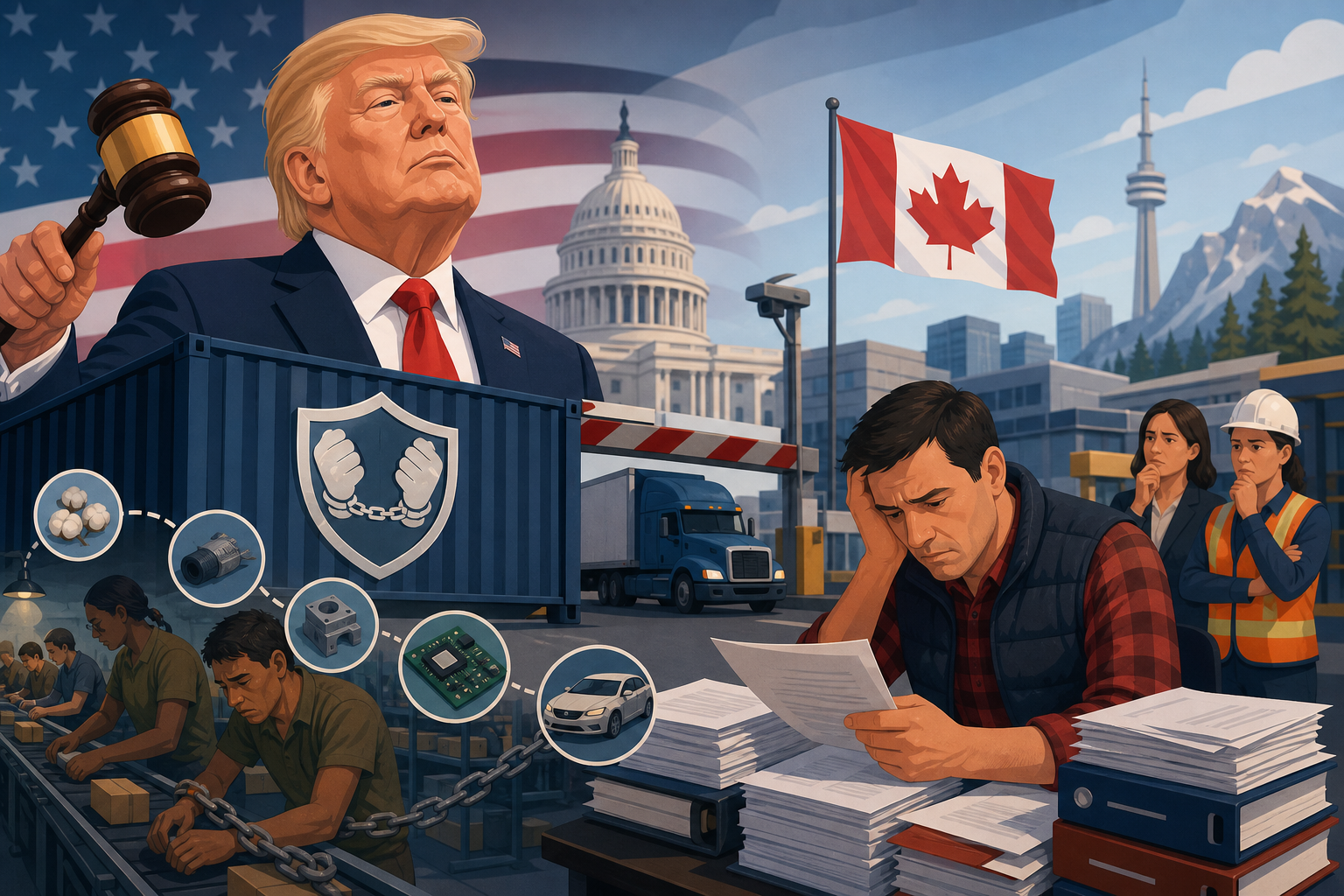
The universal 10 per cent tariff expired on Friday, July 24, 2026. In its place, the Trump administration rolled out a new framework, dozens of countries, including Canada, now face what the White House is calling "forced labour" tariffs. The stated rationale is enforcement: punishing nations that fail to crack down on goods produced under exploitative conditions. The actual target is obvious.
Canada's bilateral trade with the United States remains the largest in the world. Roughly $3.6 billion in goods and services cross the border daily. Over 75 per cent of Canadian exports head south. That volume creates leverage, and this White House knows it. By wrapping protectionist measures in the language of human rights enforcement, the administration has built a tariff regime that is politically difficult to challenge without appearing indifferent to labour exploitation.
The moral high ground as a cudgel
The shift from blanket revenue tariffs to "values-based" trade barriers is strategic. It reframes opposition. Canadian exporters who push back aren't defending free trade under the USMCA, they're defending supply chains the U.S. claims are tainted. That's a public relations disaster before the dispute even reaches a trade panel.
The legal mechanism matters here. The United States has been tightening the Uyghur Forced Labor Prevention Act framework since 2021, targeting specific regions and products. This expansion applies the same principle to entire national trade partners. It shifts the burden of proof. Canadian manufacturers must now demonstrate that no forced labour exists anywhere in their sub-tier supply chains. Proving a negative across multi-country sourcing networks is administratively and financially crushing, particularly for small and mid-sized exporters who lack the compliance infrastructure of multinational conglomerates.
Canada passed the Fighting Against Forced Labour and Child Labour in Supply Chains Act, but the White House is signaling that Canadian enforcement is insufficient. Whether that's accurate is secondary. The tariff exists either way.
Weaponizing traceability
The policy creates a fork. Canadian companies that source components from China, Southeast Asia, or other regions now face a choice: strip those suppliers from the chain entirely or accept the tariff. For industries built on just-in-time global logistics, automotive, electronics, forestry products with offshore processing, rerouting to North American-only inputs means higher costs, longer lead times, or both.
That's the structural effect. This isn't a tax that manufacturers can absorb and pass through. It forces supply chain decoupling, which was likely the point all along.
The inflationary blowback lands on U.S. consumers and manufacturers who depend on Canadian raw materials: aluminum, steel, timber, energy. These tariffs function as a domestic tax dressed up as foreign policy. But the administration has calculated that blaming Canada for "insufficient enforcement" plays better politically than admitting the cost.
The USMCA loophole
The North American trade agreement explicitly forbids most tariffs. The workaround has been Section 232 (national security) and Section 301 (unfair trade practices). Forced labour enforcement is the newest legal lever. Trade lawyers argue this violates WTO and USMCA rules. They're probably right. The dispute resolution process takes 12 to 18 months. Businesses bleeding revenue today don't have that runway.
Ambiguity of enforcement makes it worse. The U.S. has not clearly defined what constitutes "sufficient" crackdown. That leaves exporters guessing, which is its own form of friction. Tariff by discretion, not predictable trade law.
Canada's economy is structurally more vulnerable to U.S. trade shocks than any other developed nation. The administration didn't invent that dependency, but it is now monetizing it. The "forced labour" branding gives political cover. The tariff structure ensures Canada absorbs the majority of the economic damage. Both facts were understood before the order was signed.



The universal 10 per cent tariff expired on Friday, July 24, 2026. In its place, the Trump administration rolled out a new framework, dozens of countries, including Canada, now face what the White House is calling "forced labour" tariffs. The stated rationale is enforcement: punishing nations that fail to crack down on goods produced under exploitative conditions. The actual target is obvious.
Canada's bilateral trade with the United States remains the largest in the world. Roughly $3.6 billion in goods and services cross the border daily. Over 75 per cent of Canadian exports head south. That volume creates leverage, and this White House knows it. By wrapping protectionist measures in the language of human rights enforcement, the administration has built a tariff regime that is politically difficult to challenge without appearing indifferent to labour exploitation.
The moral high ground as a cudgel
The shift from blanket revenue tariffs to "values-based" trade barriers is strategic. It reframes opposition. Canadian exporters who push back aren't defending free trade under the USMCA, they're defending supply chains the U.S. claims are tainted. That's a public relations disaster before the dispute even reaches a trade panel.
The legal mechanism matters here. The United States has been tightening the Uyghur Forced Labor Prevention Act framework since 2021, targeting specific regions and products. This expansion applies the same principle to entire national trade partners. It shifts the burden of proof. Canadian manufacturers must now demonstrate that no forced labour exists anywhere in their sub-tier supply chains. Proving a negative across multi-country sourcing networks is administratively and financially crushing, particularly for small and mid-sized exporters who lack the compliance infrastructure of multinational conglomerates.
Canada passed the Fighting Against Forced Labour and Child Labour in Supply Chains Act, but the White House is signaling that Canadian enforcement is insufficient. Whether that's accurate is secondary. The tariff exists either way.
Weaponizing traceability
The policy creates a fork. Canadian companies that source components from China, Southeast Asia, or other regions now face a choice: strip those suppliers from the chain entirely or accept the tariff. For industries built on just-in-time global logistics, automotive, electronics, forestry products with offshore processing, rerouting to North American-only inputs means higher costs, longer lead times, or both.
That's the structural effect. This isn't a tax that manufacturers can absorb and pass through. It forces supply chain decoupling, which was likely the point all along.
The inflationary blowback lands on U.S. consumers and manufacturers who depend on Canadian raw materials: aluminum, steel, timber, energy. These tariffs function as a domestic tax dressed up as foreign policy. But the administration has calculated that blaming Canada for "insufficient enforcement" plays better politically than admitting the cost.
The USMCA loophole
The North American trade agreement explicitly forbids most tariffs. The workaround has been Section 232 (national security) and Section 301 (unfair trade practices). Forced labour enforcement is the newest legal lever. Trade lawyers argue this violates WTO and USMCA rules. They're probably right. The dispute resolution process takes 12 to 18 months. Businesses bleeding revenue today don't have that runway.
Ambiguity of enforcement makes it worse. The U.S. has not clearly defined what constitutes "sufficient" crackdown. That leaves exporters guessing, which is its own form of friction. Tariff by discretion, not predictable trade law.
Canada's economy is structurally more vulnerable to U.S. trade shocks than any other developed nation. The administration didn't invent that dependency, but it is now monetizing it. The "forced labour" branding gives political cover. The tariff structure ensures Canada absorbs the majority of the economic damage. Both facts were understood before the order was signed.
Read Next
Canada Lost 55,000 People This Quarter, So Why Aren't Home Prices Following?
CRA's New Billion-Dollar Ruling Program: How to Lock in Tax Certainty Before You Build
Why Porting Your 2.7% Mortgage Could Cost You $47,000 More Than Breaking It
Why Your Mortgage Renewal Is Making Crypto Look Smart (And What That Tells You)