Fifteen-plus years of BC mortgage experience, distilled into practical writing on buying, renewing, refinancing, and building wealth through real estate.
Trump's AI Border Detective Marks the End of Trade Enforcement as We Know It
A factory in Hanoi ships solar panels to Los Angeles. The bill of lading says Vietnamese origin. The chemical signature of the silicon wafer says Xinjiang. Customs and Border Protection's new machine-learning system catches the mismatch before the container clears the port.
That scenario isn't hypothetical anymore. It's the enforcement regime the Trump administration rolled out in early 2026, and it represents something more fundamental than tougher audits. We are entering an era where trade policy is no longer enforced by inspectors sampling manifests. It's enforced by algorithms that treat every shipment like a crime scene.
The Whack-a-Mole Problem Gets a Neural Network
Traditional tariff enforcement worked like this: the U.S. slaps a 60% tariff on Chinese steel. The Chinese exporter moves final assembly to Malaysia. The "country of origin" changes. The tariff disappears. Customs catches maybe 5% of these transshipment schemes through random audits. The rest slide through.
CBP processed $3.3 trillion in imports last fiscal year. Human inspectors cannot audit that volume. The agency knows it. So does every logistics broker in Shenzhen.
The AI system changes the math. It ingests shipping manifests, bills of lading, corporate ownership registries, and, critically, the Uyghur Forced Labor Prevention Act entity list. It runs pattern recognition across millions of shipments to find what CBP calls "DNA matches": shell companies with the same beneficial owners as banned entities, routing changes that correspond with tariff announcements, chemical or isotopic signatures in raw materials that don't align with claimed origins.
The system doesn't just flag anomalies. It builds what trade officials are calling "digital twins" of global supply chains. When the administration floats a new 20% baseline tariff, the model simulates where illegal rerouting will spike. Enforcement moves from reactive to predictive.
The Third-Country Buffer Collapses
Mexico and Vietnam have spent the last decade building export economies partly on the back of being plausible intermediaries. A Chinese-owned factory in Monterrey assembles components shipped from Guangdong and exports the finished product to Texas under USMCA rules. Plausible deniability held as long as the paperwork was clean.
AI removes that buffer. The system now maps Tier-3 and Tier-4 suppliers, the cotton field in Xinjiang, the steel mill in Hebei, and traces them forward through every handoff. A Mexican exporter whose supply chain shows 87% Chinese inputs but claims North American origin gets flagged. The seizure happens before the truck crosses the bridge in Laredo.
For importers, the cost of "not knowing" your deep supply chain just became catastrophic. A single algorithmic red flag can freeze six figures of inventory at the port with no warning and no clear appeal process.
What Enforcement by Algorithm Actually Means
The standard counterargument is that this closes loopholes and levels the playing field. Maybe. But algorithmic enforcement creates its own distortions.
First, false positives. A legitimate Vietnamese manufacturer that happens to buy a commodity input from a supplier two degrees removed from a blacklisted entity can get caught in the same net as a pure pass-through shell company. Small importers lack the compliance infrastructure to contest CBP findings. The big guys lawyer up. The gap widens.
Second, diplomatic friction. Aggressive AI enforcement doesn't distinguish between adversaries and allies. When a model flags a shipment from a Mexican factory for "Chinese beneficial ownership," it's not a customs dispute. It's a USMCA tension point. The algorithm doesn't do diplomacy.
Third, the data quality problem. AI is only as good as the data it consumes. Global shipping records are fragmented, self-reported, and, in many jurisdictions, laughably easy to falsify. If sophisticated exporters start deploying their own AI to generate plausible but fraudulent documentation, we get an arms race where the technology advantage decides who evades and who gets caught.
The administration calls this the future of trade enforcement. That's probably right. What it's not is neutral. Algorithmic borders don't just enforce rules. They reshape who can afford to comply.


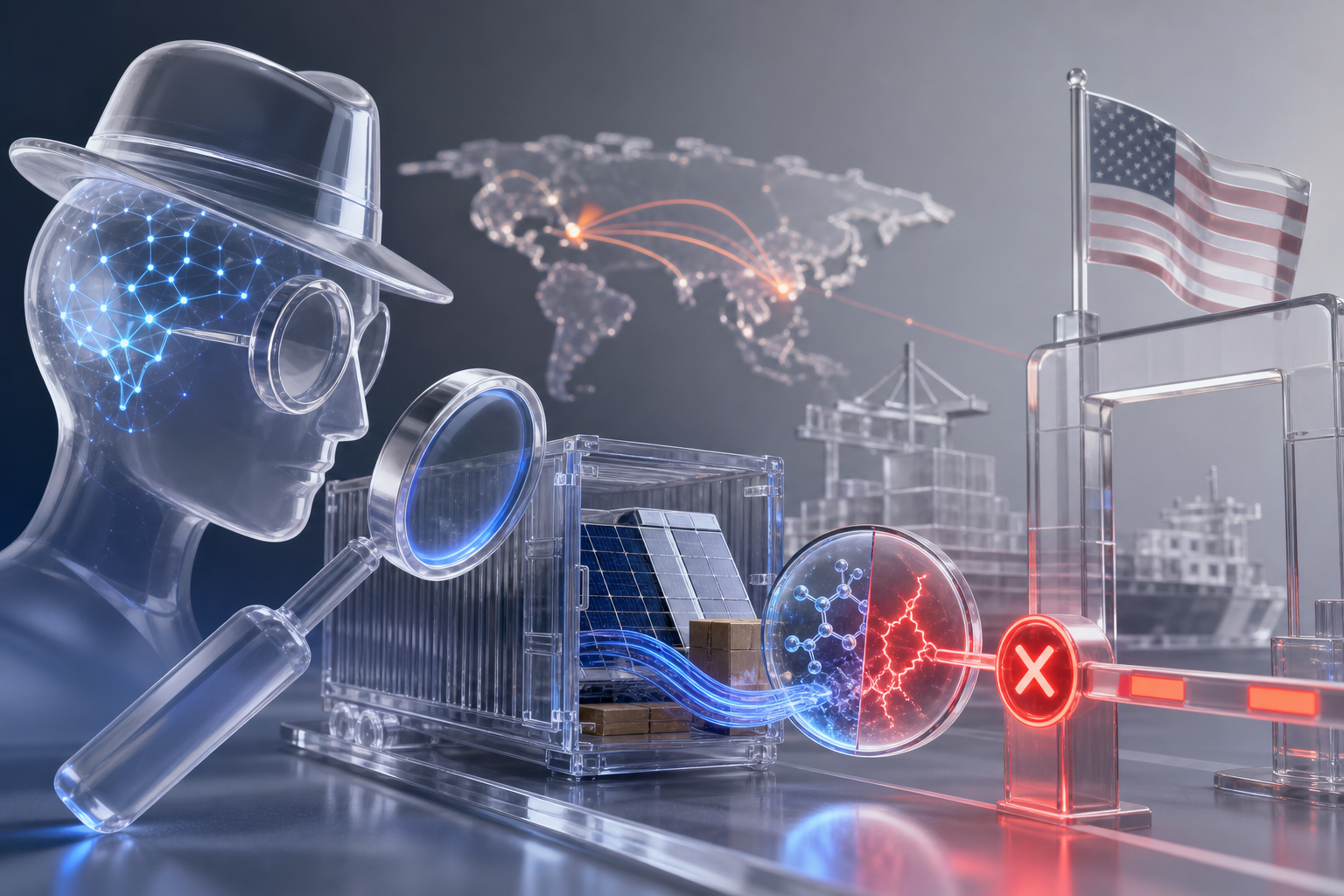

A factory in Hanoi ships solar panels to Los Angeles. The bill of lading says Vietnamese origin. The chemical signature of the silicon wafer says Xinjiang. Customs and Border Protection's new machine-learning system catches the mismatch before the container clears the port.
That scenario isn't hypothetical anymore. It's the enforcement regime the Trump administration rolled out in early 2026, and it represents something more fundamental than tougher audits. We are entering an era where trade policy is no longer enforced by inspectors sampling manifests. It's enforced by algorithms that treat every shipment like a crime scene.
The Whack-a-Mole Problem Gets a Neural Network
Traditional tariff enforcement worked like this: the U.S. slaps a 60% tariff on Chinese steel. The Chinese exporter moves final assembly to Malaysia. The "country of origin" changes. The tariff disappears. Customs catches maybe 5% of these transshipment schemes through random audits. The rest slide through.
CBP processed $3.3 trillion in imports last fiscal year. Human inspectors cannot audit that volume. The agency knows it. So does every logistics broker in Shenzhen.
The AI system changes the math. It ingests shipping manifests, bills of lading, corporate ownership registries, and, critically, the Uyghur Forced Labor Prevention Act entity list. It runs pattern recognition across millions of shipments to find what CBP calls "DNA matches": shell companies with the same beneficial owners as banned entities, routing changes that correspond with tariff announcements, chemical or isotopic signatures in raw materials that don't align with claimed origins.
The system doesn't just flag anomalies. It builds what trade officials are calling "digital twins" of global supply chains. When the administration floats a new 20% baseline tariff, the model simulates where illegal rerouting will spike. Enforcement moves from reactive to predictive.
The Third-Country Buffer Collapses
Mexico and Vietnam have spent the last decade building export economies partly on the back of being plausible intermediaries. A Chinese-owned factory in Monterrey assembles components shipped from Guangdong and exports the finished product to Texas under USMCA rules. Plausible deniability held as long as the paperwork was clean.
AI removes that buffer. The system now maps Tier-3 and Tier-4 suppliers, the cotton field in Xinjiang, the steel mill in Hebei, and traces them forward through every handoff. A Mexican exporter whose supply chain shows 87% Chinese inputs but claims North American origin gets flagged. The seizure happens before the truck crosses the bridge in Laredo.
For importers, the cost of "not knowing" your deep supply chain just became catastrophic. A single algorithmic red flag can freeze six figures of inventory at the port with no warning and no clear appeal process.
What Enforcement by Algorithm Actually Means
The standard counterargument is that this closes loopholes and levels the playing field. Maybe. But algorithmic enforcement creates its own distortions.
First, false positives. A legitimate Vietnamese manufacturer that happens to buy a commodity input from a supplier two degrees removed from a blacklisted entity can get caught in the same net as a pure pass-through shell company. Small importers lack the compliance infrastructure to contest CBP findings. The big guys lawyer up. The gap widens.
Second, diplomatic friction. Aggressive AI enforcement doesn't distinguish between adversaries and allies. When a model flags a shipment from a Mexican factory for "Chinese beneficial ownership," it's not a customs dispute. It's a USMCA tension point. The algorithm doesn't do diplomacy.
Third, the data quality problem. AI is only as good as the data it consumes. Global shipping records are fragmented, self-reported, and, in many jurisdictions, laughably easy to falsify. If sophisticated exporters start deploying their own AI to generate plausible but fraudulent documentation, we get an arms race where the technology advantage decides who evades and who gets caught.
The administration calls this the future of trade enforcement. That's probably right. What it's not is neutral. Algorithmic borders don't just enforce rules. They reshape who can afford to comply.
Read Next
Canada Lost 55,000 People This Quarter, So Why Aren't Home Prices Following?
CRA's New Billion-Dollar Ruling Program: How to Lock in Tax Certainty Before You Build
Why Porting Your 2.7% Mortgage Could Cost You $47,000 More Than Breaking It
Why Your Mortgage Renewal Is Making Crypto Look Smart (And What That Tells You)