Fifteen-plus years of BC mortgage experience, distilled into practical writing on buying, renewing, refinancing, and building wealth through real estate.
Trump sells tariffs in Michigan while the border bridge he opened strains the trade he just taxed
Six months ago, Windsor and Detroit celebrated a new span across the water. By Monday, the Gordie Howe International Bridge was moving 18,000 commercial trucks a week, most of them carrying Canadian auto parts bound for Michigan assembly plants. The U.S. President stood in Grand Rapids the same afternoon, 240 kilometres east, telling a crowd of manufacturers that a 25% tariff on those same parts would protect American jobs.
The math doesn't add up, but the politics does. Michigan is one of three states that decide U.S. presidential elections, and its auto sector has been bleeding employment since the 1990s. Tariffs poll well. Bridges do not campaign for themselves. The Gordie Howe opening, funded almost entirely by Canada at $5.7 billion CAD, was supposed to be the capstone project of integrated North American manufacturing. Instead, it became a case study in how infrastructure and trade policy can move in opposite directions when electoral logic overrides supply chain reality.
What the tariffs actually hit
The baseline tariff on Canadian steel and aluminum sits at 10%. Auto parts classified under certain HS codes face an additional 15% surcharge, pushing the effective rate to 25% on components like cast engine blocks and stamped body panels. These are not luxury inputs. They are the structural bones of vehicles assembled in Michigan, Ohio, and Indiana.
Ontario supplies roughly 40% of the aluminum used in U.S. auto manufacturing and about 22% of the steel. A single vehicle part crosses the Canada-U.S. border an average of four times during assembly, a legacy of NAFTA-era supply chain design that treated the two countries as a single production zone. Tariffs do not eliminate those crossings. They tax them. Each time.
For a mid-size sedan, industry analysts estimate the tariff cascade adds $2,100 to $3,400 in input costs, depending on powertrain complexity. That cost does not stay at the factory. It shows up in the dealer lot six months later, priced into the sticker. Michigan workers building those vehicles are not insulated from this. When the average transaction price of a domestically assembled car rises above $48,000, demand softens, shifts flatten, and plants idle.
The bridge that opened into a trade war
The Gordie Howe Bridge was engineered to handle 8 million vehicles per year at capacity. It opened in September 2025 to handle current volumes around 125,000 per week, with projected growth baked into the revenue model that justified Canada's upfront investment. That growth assumed continued integration, not friction.
By late 2025, the rhetoric shifted. The U.S. invoked Section 232 of the Trade Expansion Act, the same statute used to designate Canadian steel as a "national security threat" in prior administrations. Ottawa responded with dollar-for-dollar countermeasures, targeting Michigan cherries, Ohio fabricated metals, and Wisconsin dairy. The diplomatic opening of the bridge in September was boycotted by three Canadian cabinet ministers.
The bridge still moves trucks. What it does not move is the assumption that cross-border infrastructure means cross-border cooperation. The span is now a monument to a trade framework that no longer exists.
Who wins when tariffs cost more than they earn
Proponents argue tariffs fund domestic reindustrialization. The math is harder than the rhetoric. A 25% tariff on $60 billion in annual Canadian auto parts generates roughly $15 billion in revenue for the U.S. Treasury. Rebuilding primary aluminum smelting capacity in Michigan to replace Ontario supply costs an estimated $8 billion per facility, requires 7-10 years to permit and construct, and depends on electricity prices staying below $0.045 per kWh, a rate Michigan has not seen since 2009.
The gap between tariff revenue and reshoring cost is not theoretical. It is the reason every prior attempt to reshore aluminum production has stalled at the feasibility study. The tariffs do not solve that problem. They import inflation while the domestic alternative remains unbuilt.
Canada's leverage is time. Michigan manufacturers cannot wait a decade for new smelters. They pay the tariff now, raise prices, and watch market share erode to imports from Mexico, which remains tariff-exempt under USMCA carve-outs for legacy assembly. The bridge keeps moving trucks. The cargo just costs more, and the profits flow somewhere else.


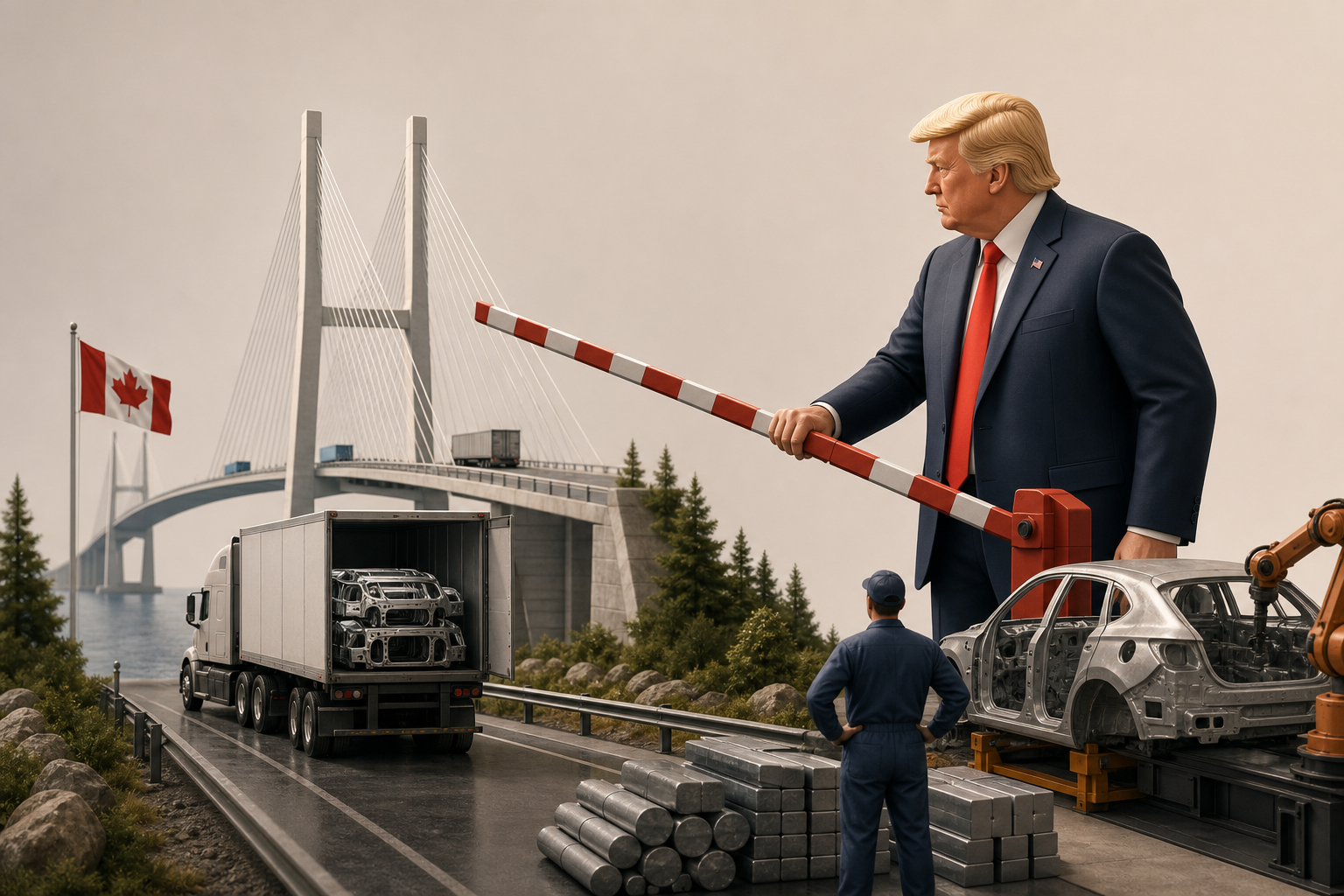

Six months ago, Windsor and Detroit celebrated a new span across the water. By Monday, the Gordie Howe International Bridge was moving 18,000 commercial trucks a week, most of them carrying Canadian auto parts bound for Michigan assembly plants. The U.S. President stood in Grand Rapids the same afternoon, 240 kilometres east, telling a crowd of manufacturers that a 25% tariff on those same parts would protect American jobs.
The math doesn't add up, but the politics does. Michigan is one of three states that decide U.S. presidential elections, and its auto sector has been bleeding employment since the 1990s. Tariffs poll well. Bridges do not campaign for themselves. The Gordie Howe opening, funded almost entirely by Canada at $5.7 billion CAD, was supposed to be the capstone project of integrated North American manufacturing. Instead, it became a case study in how infrastructure and trade policy can move in opposite directions when electoral logic overrides supply chain reality.
What the tariffs actually hit
The baseline tariff on Canadian steel and aluminum sits at 10%. Auto parts classified under certain HS codes face an additional 15% surcharge, pushing the effective rate to 25% on components like cast engine blocks and stamped body panels. These are not luxury inputs. They are the structural bones of vehicles assembled in Michigan, Ohio, and Indiana.
Ontario supplies roughly 40% of the aluminum used in U.S. auto manufacturing and about 22% of the steel. A single vehicle part crosses the Canada-U.S. border an average of four times during assembly, a legacy of NAFTA-era supply chain design that treated the two countries as a single production zone. Tariffs do not eliminate those crossings. They tax them. Each time.
For a mid-size sedan, industry analysts estimate the tariff cascade adds $2,100 to $3,400 in input costs, depending on powertrain complexity. That cost does not stay at the factory. It shows up in the dealer lot six months later, priced into the sticker. Michigan workers building those vehicles are not insulated from this. When the average transaction price of a domestically assembled car rises above $48,000, demand softens, shifts flatten, and plants idle.
The bridge that opened into a trade war
The Gordie Howe Bridge was engineered to handle 8 million vehicles per year at capacity. It opened in September 2025 to handle current volumes around 125,000 per week, with projected growth baked into the revenue model that justified Canada's upfront investment. That growth assumed continued integration, not friction.
By late 2025, the rhetoric shifted. The U.S. invoked Section 232 of the Trade Expansion Act, the same statute used to designate Canadian steel as a "national security threat" in prior administrations. Ottawa responded with dollar-for-dollar countermeasures, targeting Michigan cherries, Ohio fabricated metals, and Wisconsin dairy. The diplomatic opening of the bridge in September was boycotted by three Canadian cabinet ministers.
The bridge still moves trucks. What it does not move is the assumption that cross-border infrastructure means cross-border cooperation. The span is now a monument to a trade framework that no longer exists.
Who wins when tariffs cost more than they earn
Proponents argue tariffs fund domestic reindustrialization. The math is harder than the rhetoric. A 25% tariff on $60 billion in annual Canadian auto parts generates roughly $15 billion in revenue for the U.S. Treasury. Rebuilding primary aluminum smelting capacity in Michigan to replace Ontario supply costs an estimated $8 billion per facility, requires 7-10 years to permit and construct, and depends on electricity prices staying below $0.045 per kWh, a rate Michigan has not seen since 2009.
The gap between tariff revenue and reshoring cost is not theoretical. It is the reason every prior attempt to reshore aluminum production has stalled at the feasibility study. The tariffs do not solve that problem. They import inflation while the domestic alternative remains unbuilt.
Canada's leverage is time. Michigan manufacturers cannot wait a decade for new smelters. They pay the tariff now, raise prices, and watch market share erode to imports from Mexico, which remains tariff-exempt under USMCA carve-outs for legacy assembly. The bridge keeps moving trucks. The cargo just costs more, and the profits flow somewhere else.
Read Next
Canada Lost 55,000 People This Quarter, So Why Aren't Home Prices Following?
CRA's New Billion-Dollar Ruling Program: How to Lock in Tax Certainty Before You Build
Why Porting Your 2.7% Mortgage Could Cost You $47,000 More Than Breaking It
Why Your Mortgage Renewal Is Making Crypto Look Smart (And What That Tells You)