Fifteen-plus years of BC mortgage experience, distilled into practical writing on buying, renewing, refinancing, and building wealth through real estate.
Canadian Commercial Real Estate Stabilizes, Then Trump Announces Tariffs
Canadian Commercial Real Estate Stabilizes, Then Trump Announces Tariffs
A Class A office tower in downtown Toronto closed a refinancing deal in June at terms that would have seemed impossible 18 months earlier. The lender didn't blink at the vacancy floor. The sponsor didn't have to inject additional equity. The whole transaction took six weeks. That's what stability looks like after two years of chaos.
Avison Young's mid-2026 report confirms what deals like that already suggested: Canadian commercial real estate has stopped lurching. Valuations aren't climbing, but they aren't collapsing either. Capitalization rates have plateaued around levels that reflect the Bank of Canada's terminal rate environment, somewhere north of the 2020-2021 lows but well south of panic. Landlords who survived the refinancing wave of 2024 and early 2025 now have predictable debt costs. The sector is breathing normally.
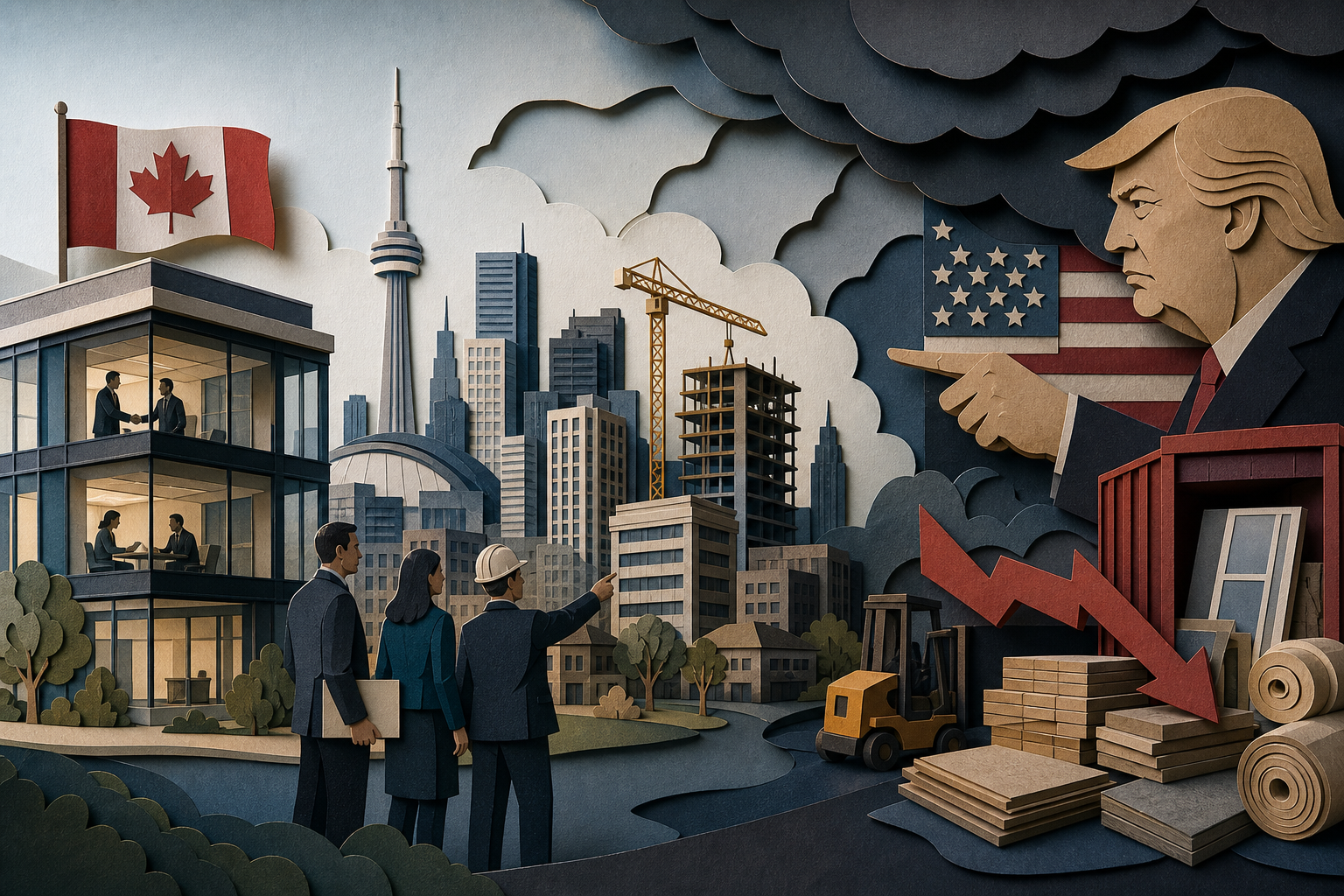
Then Washington announced new tariffs in late July.
The immediate impact isn't on tenant demand or occupancy. It's on construction economics. Specialized materials, steel framing components, certain HVAC systems, elevator parts sourced through U.S. supply chains, just got 6% to 8% more expensive overnight, according to early contractor estimates. That margin is the difference between a project penciling and a project getting shelved for six months while the sponsor reworks the pro forma.
The stabilization was real, but narrow
The calm that Avison Young is documenting applies unevenly. Industrial and logistics assets in the Greater Toronto Area and Greater Vancouver continue to post sub-5% vacancy rates, anchored by e-commerce distribution demand that hasn't softened. Multi-family remains overbuilt in some submarkets but underbuilt in others, creating strange pockets of simultaneous glut and shortage within the same metro.
Office is the messy middle. Class A buildings with ESG certifications and floor plates designed for hybrid work are holding tenant interest. Class B and C inventory, anything built before 2010 without major retrofits, is facing a structural problem that has nothing to do with interest rates. Tenants have right-sized their footprints and moved up-market. The buildings they left behind aren't coming back without conversion or demolition.
Nationally aggregated data smooths over those gaps. The headline "stabilization" is accurate for the sector's center of gravity but misleading for anyone trying to underwrite a specific asset in a specific postal code.
Tariffs hit the yield story, not the occupancy story
The tariff disruption isn't about leasing velocity. It's about capital allocation. Institutional investors spent the first half of 2026 rotating into Canadian real estate on a "bond-plus" thesis: stable cash flows, predictable yields, lower volatility than U.S. markets facing their own political noise. New construction costs rising by mid-single digits don't kill that thesis, but they do compress the development pipeline, which means less new supply coming online in 2027 and 2028.
Less supply should, in theory, support occupancy and rents for existing assets. But it also signals to LPs that the growth story is over. You're buying yield, not appreciation. That's fine if you came in expecting yield. It's a problem if you underwrote to 4% annual NOI growth driven by rent expansion in a supply-constrained market.
The real risk is refinancing maturity walls. Assets purchased in 2020 and 2021 at sub-2% rates are rolling into 2026 and 2027 refis at 5% or higher. Stabilization in occupancy doesn't fix a debt service coverage ratio that just dropped below 1.2x. The tariff shock adds construction cost uncertainty on top of that refinancing pressure, making lenders even more conservative on advance rates.
Canada's commercial real estate market was finally finding equilibrium. Then the rules changed, again, from outside. Stability is real, but it's not the same thing as predictability.



Canadian Commercial Real Estate Stabilizes, Then Trump Announces Tariffs
A Class A office tower in downtown Toronto closed a refinancing deal in June at terms that would have seemed impossible 18 months earlier. The lender didn't blink at the vacancy floor. The sponsor didn't have to inject additional equity. The whole transaction took six weeks. That's what stability looks like after two years of chaos.
Avison Young's mid-2026 report confirms what deals like that already suggested: Canadian commercial real estate has stopped lurching. Valuations aren't climbing, but they aren't collapsing either. Capitalization rates have plateaued around levels that reflect the Bank of Canada's terminal rate environment, somewhere north of the 2020-2021 lows but well south of panic. Landlords who survived the refinancing wave of 2024 and early 2025 now have predictable debt costs. The sector is breathing normally.
Then Washington announced new tariffs in late July.
The immediate impact isn't on tenant demand or occupancy. It's on construction economics. Specialized materials, steel framing components, certain HVAC systems, elevator parts sourced through U.S. supply chains, just got 6% to 8% more expensive overnight, according to early contractor estimates. That margin is the difference between a project penciling and a project getting shelved for six months while the sponsor reworks the pro forma.
The stabilization was real, but narrow
The calm that Avison Young is documenting applies unevenly. Industrial and logistics assets in the Greater Toronto Area and Greater Vancouver continue to post sub-5% vacancy rates, anchored by e-commerce distribution demand that hasn't softened. Multi-family remains overbuilt in some submarkets but underbuilt in others, creating strange pockets of simultaneous glut and shortage within the same metro.
Office is the messy middle. Class A buildings with ESG certifications and floor plates designed for hybrid work are holding tenant interest. Class B and C inventory, anything built before 2010 without major retrofits, is facing a structural problem that has nothing to do with interest rates. Tenants have right-sized their footprints and moved up-market. The buildings they left behind aren't coming back without conversion or demolition.
Nationally aggregated data smooths over those gaps. The headline "stabilization" is accurate for the sector's center of gravity but misleading for anyone trying to underwrite a specific asset in a specific postal code.
Tariffs hit the yield story, not the occupancy story
The tariff disruption isn't about leasing velocity. It's about capital allocation. Institutional investors spent the first half of 2026 rotating into Canadian real estate on a "bond-plus" thesis: stable cash flows, predictable yields, lower volatility than U.S. markets facing their own political noise. New construction costs rising by mid-single digits don't kill that thesis, but they do compress the development pipeline, which means less new supply coming online in 2027 and 2028.
Less supply should, in theory, support occupancy and rents for existing assets. But it also signals to LPs that the growth story is over. You're buying yield, not appreciation. That's fine if you came in expecting yield. It's a problem if you underwrote to 4% annual NOI growth driven by rent expansion in a supply-constrained market.
The real risk is refinancing maturity walls. Assets purchased in 2020 and 2021 at sub-2% rates are rolling into 2026 and 2027 refis at 5% or higher. Stabilization in occupancy doesn't fix a debt service coverage ratio that just dropped below 1.2x. The tariff shock adds construction cost uncertainty on top of that refinancing pressure, making lenders even more conservative on advance rates.
Canada's commercial real estate market was finally finding equilibrium. Then the rules changed, again, from outside. Stability is real, but it's not the same thing as predictability.
Read Next
Canada Lost 55,000 People This Quarter, So Why Aren't Home Prices Following?
CRA's New Billion-Dollar Ruling Program: How to Lock in Tax Certainty Before You Build
Why Porting Your 2.7% Mortgage Could Cost You $47,000 More Than Breaking It
Why Your Mortgage Renewal Is Making Crypto Look Smart (And What That Tells You)