Fifteen-plus years of BC mortgage experience, distilled into practical writing on buying, renewing, refinancing, and building wealth through real estate.
25 States Sue Trump Over Tariffs, Testing the Outer Limits of Executive Trade Power
California filed in the U.S. Court of International Trade late Friday with a complaint listing twenty-four co-plaintiffs. The administration had announced duties ranging from 10% to 60% just eleven days earlier. By Monday morning, port traffic in Los Angeles had slowed 14% as importers held shipments pending the outcome.
The legal theory behind the multi-state lawsuit is not that tariffs are bad policy. It is that Congress never gave the President the authority to impose what functions, in the plaintiffs' framing, as a nationwide sales tax without legislative approval. Article I, Section 8 of the Constitution grants Congress the power to lay and collect duties. Over the past sixty years, Congress has delegated pieces of that power to the executive branch through statutes like the Trade Expansion Act of 1962 and the Trade Act of 1974. The question now is whether those delegations have a ceiling, and if so, whether the 2026 tariffs exceed it.
Why "National Security" Became the Legal Flashpoint
The administration is using Section 232 of the Trade Expansion Act as its statutory justification. Section 232 allows the President to restrict imports that threaten to impair national security. The provision was written during the Cold War to protect domestic steel and aluminum production for military use. It has since been stretched to cover washing machines, semiconductors, and now consumer electronics assembled in allied nations.
The plaintiffs argue that applying a national security rationale to goods like Canadian-made furniture or Mexican-assembled smartphones is arbitrary under the Administrative Procedure Act. The APA requires federal agencies to provide a reasoned basis for regulatory decisions and to allow public comment before implementation. The tariffs went into effect with a seventy-two-hour notice period and no formal comment window. For comparison, the Federal Reserve's 2023 stress-test rule revisions went through a ninety-day comment cycle.
What makes this case different from prior tariff challenges is the scale. The 2018 steel and aluminum tariffs applied to roughly $48 billion in annual imports. The current package targets an estimated $430 billion, which is enough to move CPI by a detectable margin. The Tax Foundation projects the tariffs will cost the average household an additional $4,000 annually if fully passed through to retail prices. States argue this qualifies as a tax in everything but name.
The "Major Questions" Opening
Legal scholars watching the case expect the plaintiffs to invoke the Supreme Court's recent "major questions doctrine," which holds that Congress must speak clearly when delegating authority over issues of vast economic or political significance. The Court used this reasoning to strike down the EPA's 2015 Clean Power Plan and OSHA's 2021 vaccine mandate for large employers. If a trade action affects half a trillion dollars in commerce and directly impacts consumer prices, the argument goes, that crosses the threshold into "major."
The administration's counter-argument leans on precedent. Courts have historically granted the President wide deference in foreign policy and national security. In the 1936 case United States v. Curtiss-Wright Export Corp., the Supreme Court described the executive as having "plenary and exclusive power" in external affairs. Trade has traditionally been treated as foreign policy. The question is whether that deference survives when the primary domestic effect is a price increase at Walmart.
Congress has not moved to reclaim its trade authority since the tariffs were announced. That silence could cut either way. The administration may argue it as implicit consent. The states will argue that the courts exist precisely because Congress cannot be relied upon to police its own delegations.
The case will likely be appealed to the Supreme Court by mid-2027. Until then, the tariffs stay in place.


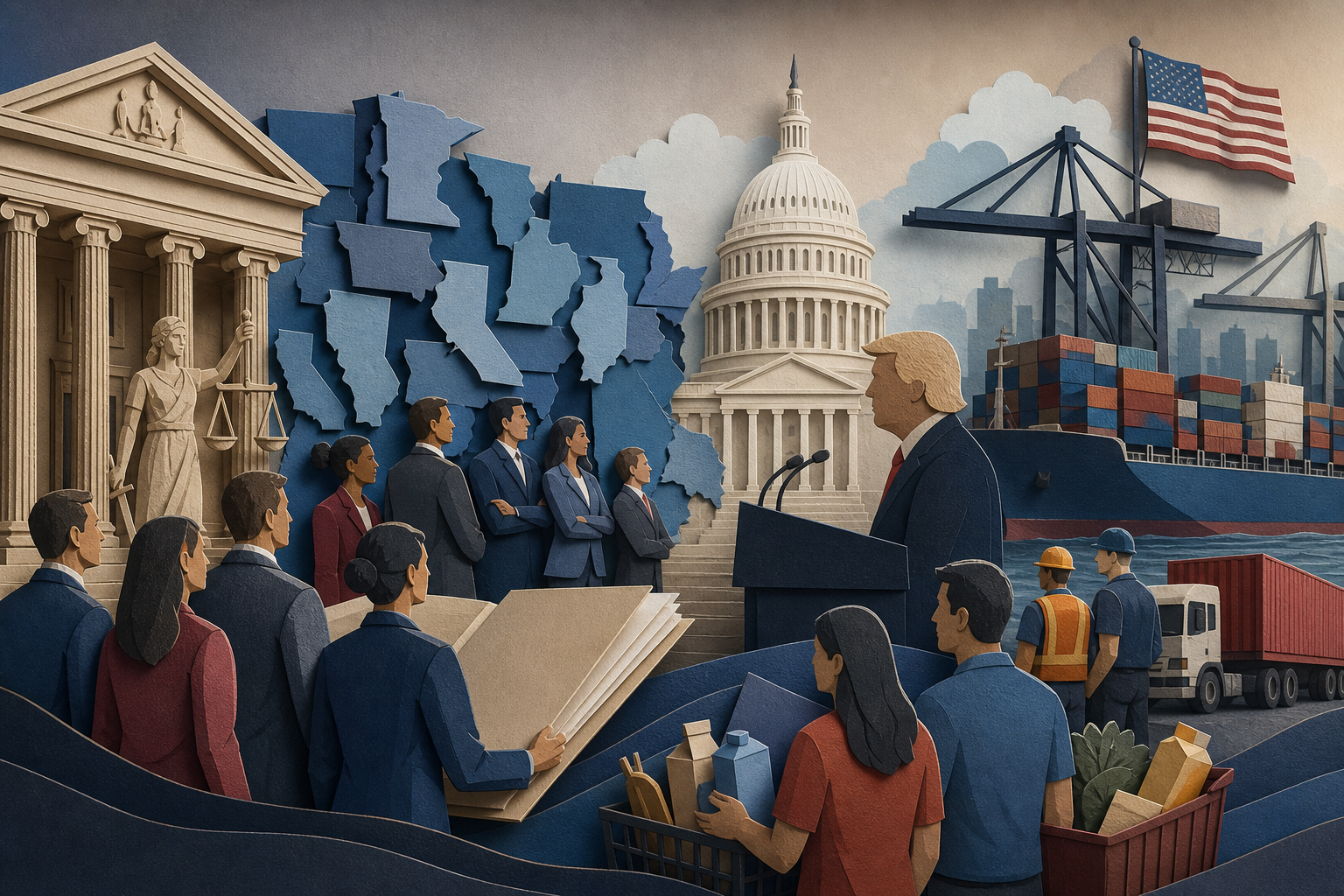

California filed in the U.S. Court of International Trade late Friday with a complaint listing twenty-four co-plaintiffs. The administration had announced duties ranging from 10% to 60% just eleven days earlier. By Monday morning, port traffic in Los Angeles had slowed 14% as importers held shipments pending the outcome.
The legal theory behind the multi-state lawsuit is not that tariffs are bad policy. It is that Congress never gave the President the authority to impose what functions, in the plaintiffs' framing, as a nationwide sales tax without legislative approval. Article I, Section 8 of the Constitution grants Congress the power to lay and collect duties. Over the past sixty years, Congress has delegated pieces of that power to the executive branch through statutes like the Trade Expansion Act of 1962 and the Trade Act of 1974. The question now is whether those delegations have a ceiling, and if so, whether the 2026 tariffs exceed it.
Why "National Security" Became the Legal Flashpoint
The administration is using Section 232 of the Trade Expansion Act as its statutory justification. Section 232 allows the President to restrict imports that threaten to impair national security. The provision was written during the Cold War to protect domestic steel and aluminum production for military use. It has since been stretched to cover washing machines, semiconductors, and now consumer electronics assembled in allied nations.
The plaintiffs argue that applying a national security rationale to goods like Canadian-made furniture or Mexican-assembled smartphones is arbitrary under the Administrative Procedure Act. The APA requires federal agencies to provide a reasoned basis for regulatory decisions and to allow public comment before implementation. The tariffs went into effect with a seventy-two-hour notice period and no formal comment window. For comparison, the Federal Reserve's 2023 stress-test rule revisions went through a ninety-day comment cycle.
What makes this case different from prior tariff challenges is the scale. The 2018 steel and aluminum tariffs applied to roughly $48 billion in annual imports. The current package targets an estimated $430 billion, which is enough to move CPI by a detectable margin. The Tax Foundation projects the tariffs will cost the average household an additional $4,000 annually if fully passed through to retail prices. States argue this qualifies as a tax in everything but name.
The "Major Questions" Opening
Legal scholars watching the case expect the plaintiffs to invoke the Supreme Court's recent "major questions doctrine," which holds that Congress must speak clearly when delegating authority over issues of vast economic or political significance. The Court used this reasoning to strike down the EPA's 2015 Clean Power Plan and OSHA's 2021 vaccine mandate for large employers. If a trade action affects half a trillion dollars in commerce and directly impacts consumer prices, the argument goes, that crosses the threshold into "major."
The administration's counter-argument leans on precedent. Courts have historically granted the President wide deference in foreign policy and national security. In the 1936 case United States v. Curtiss-Wright Export Corp., the Supreme Court described the executive as having "plenary and exclusive power" in external affairs. Trade has traditionally been treated as foreign policy. The question is whether that deference survives when the primary domestic effect is a price increase at Walmart.
Congress has not moved to reclaim its trade authority since the tariffs were announced. That silence could cut either way. The administration may argue it as implicit consent. The states will argue that the courts exist precisely because Congress cannot be relied upon to police its own delegations.
The case will likely be appealed to the Supreme Court by mid-2027. Until then, the tariffs stay in place.
Read Next
Canada Lost 55,000 People This Quarter, So Why Aren't Home Prices Following?
CRA's New Billion-Dollar Ruling Program: How to Lock in Tax Certainty Before You Build
Why Porting Your 2.7% Mortgage Could Cost You $47,000 More Than Breaking It
Why Your Mortgage Renewal Is Making Crypto Look Smart (And What That Tells You)