Fifteen-plus years of BC mortgage experience, distilled into practical writing on buying, renewing, refinancing, and building wealth through real estate.
A Toronto Townhouse Project Built 147 Units and Can't Sell 65 of Them
Solotex Group finished building its townhomes on Victoria Park Avenue in 2024 and discovered that "finished" no longer means "done." The project, called The Vic Towns, had 147 stacked units ready for occupancy. Eighty-two of them sold. The remaining 65 sat empty while the interest clock ran on construction debt the developer couldn't retire. In November 2024, Solotex filed for creditor protection under the Companies' Creditors Arrangement Act. KSV Restructuring Inc. was appointed as monitor. The filing described a liquidity crisis driven entirely by unsold completed inventory in a market where buyer demand had evaporated faster than anyone building in 2022 had anticipated.
The math that broke the project is the math that breaks most projects of this type. Developers typically carry bridge financing on a construction project with the expectation that unit closings will generate enough cash to pay down the loan and release the lender's security. That works when 80% or 90% of the units close within six months of occupancy. It stops working when half the building doesn't close at all. The carrying cost on 65 empty units, interest, property tax, condo fees, utilities, runs somewhere between $40,000 and $60,000 per month depending on how the loan was structured. The developer has no rental income from those units because they aren't rental stock. They're registered condos with no occupants. The cash outflow is pure.
Why the Last Third Matters More Than the First Two
Most residential projects break even somewhere around 60% to 70% of units sold. Everything after that is where the profit sits and where the ability to repay senior debt comes from. Solotex got to 56%. The difference between 56% and 70% is not incremental. It's the difference between survival and insolvency. The final third of a project's sales aren't just revenue. They're the capital structure.
The Vic Towns opened into the worst new-home sales environment the Greater Toronto Area has seen in two decades. In the second half of 2024, new townhome transactions in the GTA were running 60% to 70% below the previous year's already-depressed figures, per BILD's monthly tracking. The Bank of Canada held its policy rate at 5.0% through mid-2024, which translated to mortgage rates for qualified buyers in the mid-6% range. A $950,000 townhome, which is roughly the midpoint of pricing for stacked units in North York, carried a monthly payment north of $5,400 at those rates. That put the product outside the range most end-users could qualify for and outside the range most small investors were willing to pay given that rents in the area were running at $3,200 for comparable three-bedroom units.
What Court Protection Actually Buys
Creditor protection under the CCAA isn't liquidation. It's a supervised sales process. The court appoints a monitor who oversees the company's operations and reports to creditors. The developer stays in control but operates under constraints. For buyers, it creates a layer of confidence that wasn't there before the filing. Deposits on unsold units are held in trust under court supervision. The risk of buying into a distressed project, where the deposit might disappear if the builder collapses, drops sharply. Some projects that file under CCAA see a sales pickup within 60 to 90 days because the filing itself signals to the market that inventory is available and the court is watching the money.
Solotex has a functioning building in a transit-adjacent pocket of North York a few blocks from Eglinton Square. The location isn't the problem. The price-to-market fit in a 6% mortgage environment is the problem. The 82 units that sold are occupied. The community exists. What remains is a bulk of unsold units that likely need to be repriced or sold as a portfolio to an institutional landlord willing to operate them as purpose-built rental. That would stabilize the finances. It would also remove 65 units from the ownership pipeline in a city that already has too few of them.


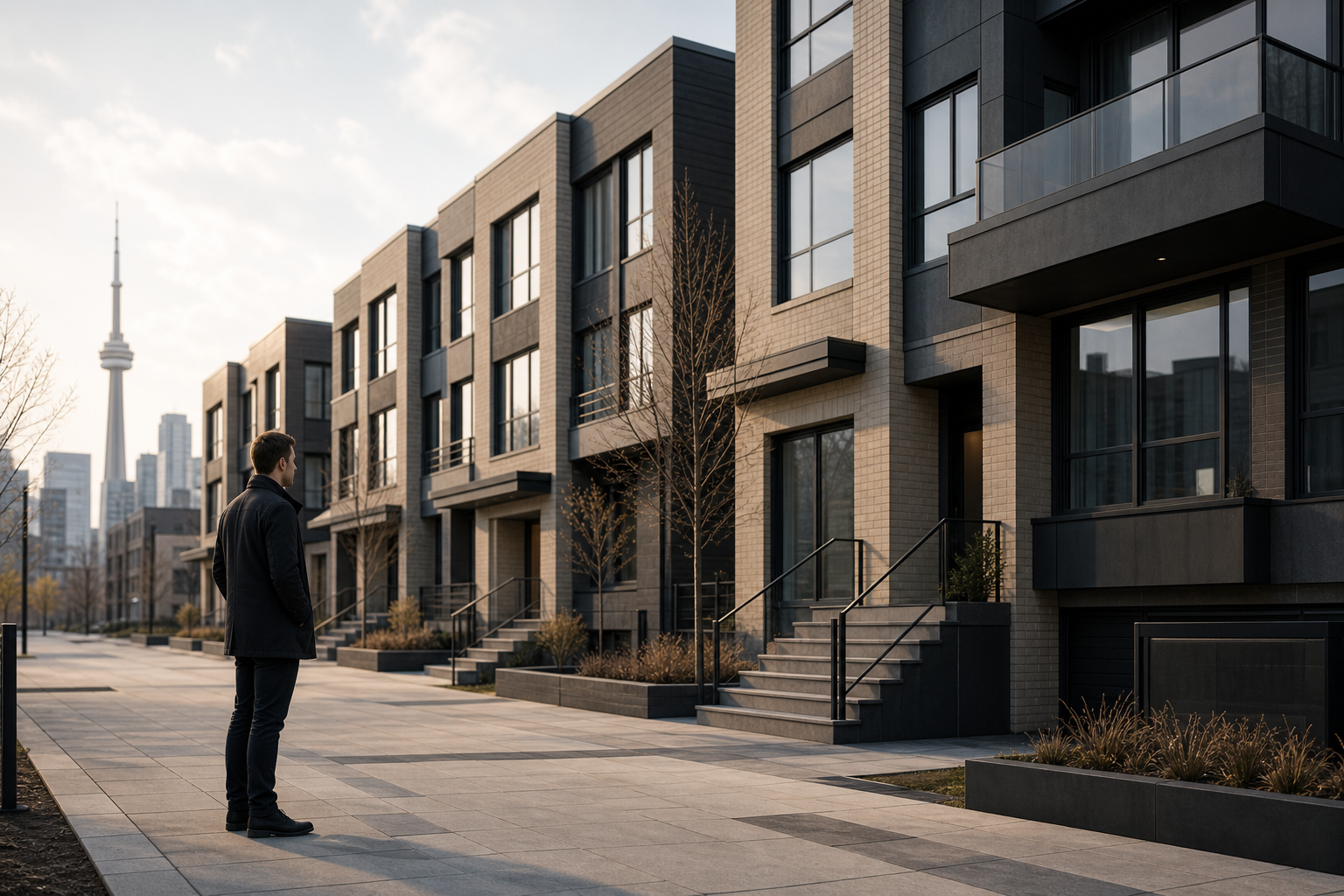

Solotex Group finished building its townhomes on Victoria Park Avenue in 2024 and discovered that "finished" no longer means "done." The project, called The Vic Towns, had 147 stacked units ready for occupancy. Eighty-two of them sold. The remaining 65 sat empty while the interest clock ran on construction debt the developer couldn't retire. In November 2024, Solotex filed for creditor protection under the Companies' Creditors Arrangement Act. KSV Restructuring Inc. was appointed as monitor. The filing described a liquidity crisis driven entirely by unsold completed inventory in a market where buyer demand had evaporated faster than anyone building in 2022 had anticipated.
The math that broke the project is the math that breaks most projects of this type. Developers typically carry bridge financing on a construction project with the expectation that unit closings will generate enough cash to pay down the loan and release the lender's security. That works when 80% or 90% of the units close within six months of occupancy. It stops working when half the building doesn't close at all. The carrying cost on 65 empty units, interest, property tax, condo fees, utilities, runs somewhere between $40,000 and $60,000 per month depending on how the loan was structured. The developer has no rental income from those units because they aren't rental stock. They're registered condos with no occupants. The cash outflow is pure.
Why the Last Third Matters More Than the First Two
Most residential projects break even somewhere around 60% to 70% of units sold. Everything after that is where the profit sits and where the ability to repay senior debt comes from. Solotex got to 56%. The difference between 56% and 70% is not incremental. It's the difference between survival and insolvency. The final third of a project's sales aren't just revenue. They're the capital structure.
The Vic Towns opened into the worst new-home sales environment the Greater Toronto Area has seen in two decades. In the second half of 2024, new townhome transactions in the GTA were running 60% to 70% below the previous year's already-depressed figures, per BILD's monthly tracking. The Bank of Canada held its policy rate at 5.0% through mid-2024, which translated to mortgage rates for qualified buyers in the mid-6% range. A $950,000 townhome, which is roughly the midpoint of pricing for stacked units in North York, carried a monthly payment north of $5,400 at those rates. That put the product outside the range most end-users could qualify for and outside the range most small investors were willing to pay given that rents in the area were running at $3,200 for comparable three-bedroom units.
What Court Protection Actually Buys
Creditor protection under the CCAA isn't liquidation. It's a supervised sales process. The court appoints a monitor who oversees the company's operations and reports to creditors. The developer stays in control but operates under constraints. For buyers, it creates a layer of confidence that wasn't there before the filing. Deposits on unsold units are held in trust under court supervision. The risk of buying into a distressed project, where the deposit might disappear if the builder collapses, drops sharply. Some projects that file under CCAA see a sales pickup within 60 to 90 days because the filing itself signals to the market that inventory is available and the court is watching the money.
Solotex has a functioning building in a transit-adjacent pocket of North York a few blocks from Eglinton Square. The location isn't the problem. The price-to-market fit in a 6% mortgage environment is the problem. The 82 units that sold are occupied. The community exists. What remains is a bulk of unsold units that likely need to be repriced or sold as a portfolio to an institutional landlord willing to operate them as purpose-built rental. That would stabilize the finances. It would also remove 65 units from the ownership pipeline in a city that already has too few of them.
Read Next
Brokers Who Think the Filogix Acquisition Changes Nothing Are Missing the Strategic Shift
DLC didn't buy Filogix to own the rails, it bought it because the rails were already failing
MCAN's 19% earnings jump hides a rising impairment problem
Personal Letters Still Win Toronto Homes When Everyone Else Assumes They Don't